


Which Is Best Between SaaS Marketing Agency And In-House Team When Budgets Are Limited?
When budgets are tight, deciding which is best between SaaS marketing agency and in-house team becomes a critical business decision, not a nice-to-have discussion. Every marketing dollar must justify its impact on pipeline, growth, and revenue. For SaaS companies, especially those relying on content to drive demand, a wrong choice can stall growth for months.
The most common mistake SaaS teams make is treating this as a preference decision based on comfort, control, or past experience. Hiring in-house feels safer, while agencies seem expensive upfront. In reality, limited budgets magnify inefficiencies. One wrong hire or misaligned agency can burn the budget faster than expected.
This decision is ultimately about revenue efficiency. You are not choosing between people and partners. You are choosing the fastest, most predictable path to qualified leads, consistent content output, and measurable ROI.
Understanding The Two Models in SaaS Marketing
Before deciding which path makes sense, it is important to clearly understand how each model actually works in real SaaS environments.
What an In-House SaaS Marketing Team Looks Like
An in-house team focuses on internal control and long-term ownership of marketing execution.
Typical roles required for SaaS growth
- Content marketer to handle blogs, use cases, and thought leadership
- SEO specialist for organic growth and technical optimization
- Paid acquisition expert for Google Ads and social media
- CRO specialist to improve landing pages and conversions
- Analytics and reporting resource to track pipeline impact
Fixed costs vs output reality
- Salaries and tools are paid regardless of performance
- Hiring and ramp-up time slows execution
- Limited headcount often leads to skill gaps
While in-house teams offer control, agencies take a very different approach to solving the same growth problem.
What A SaaS Marketing Agency Actually Provides
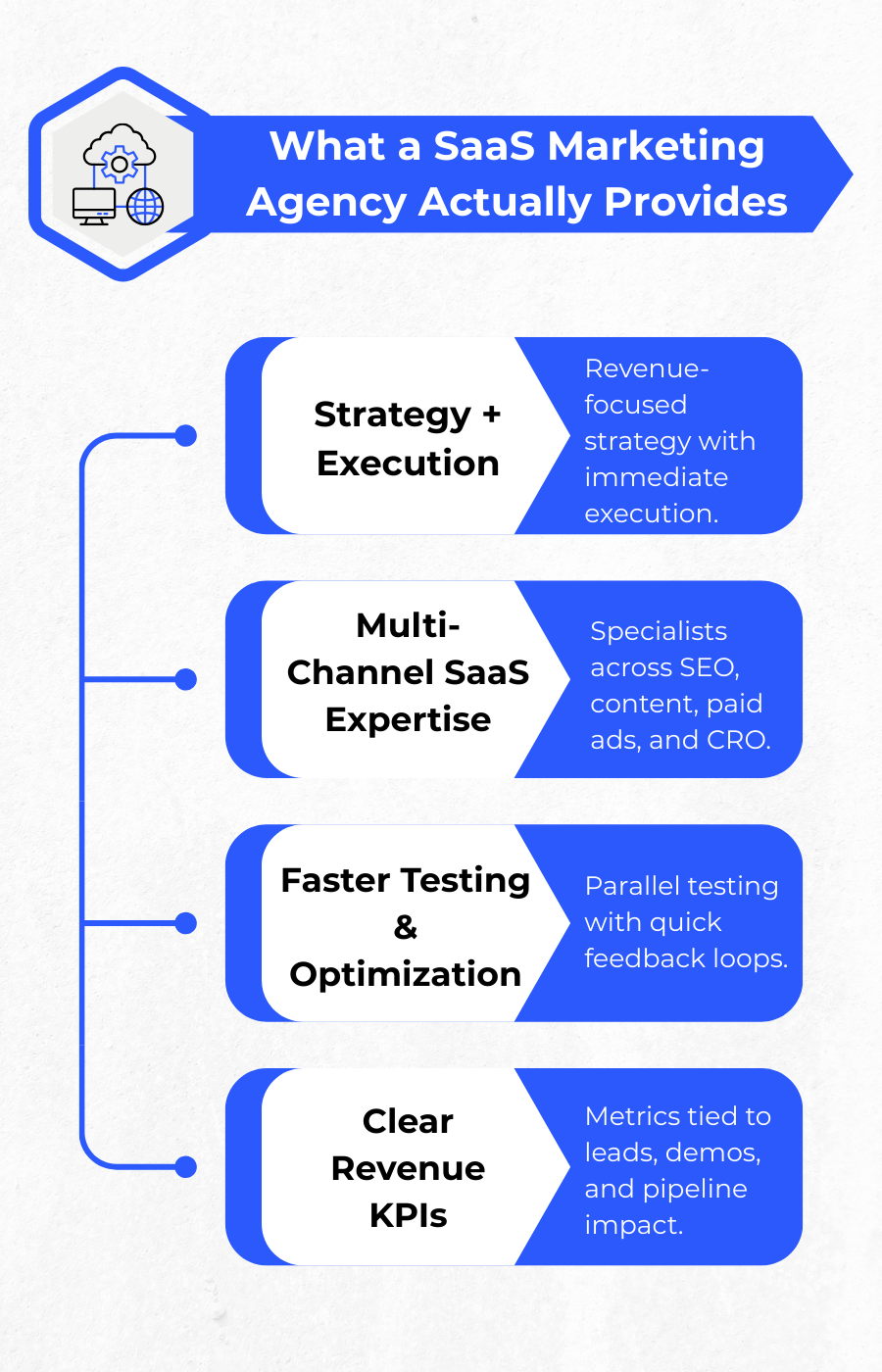
A SaaS marketing agency is designed to deliver outcomes, not just resources.
Strategy plus execution bundled
- Growth strategy aligned with SaaS revenue goals
- Immediate execution without hiring delays
Clear KPIs tied to lead generation, demos, and pipeline
Access to multi-channel SaaS expertise
- Specialists across content, SEO, paid acquisition, and CRO
- Experience from working with multiple SaaS companies
- Proven frameworks instead of trial and error
Faster testing across channels
- Parallel testing across SEO, content, paid ads, and CRO
- Faster feedback loops and optimization
- Budget shifted toward channels that perform
Now that the two models are clear, the next step is understanding how budget constraints change the outcome of this decision.
Choosing between an agency or in-house team depends on staying ahead of SaaS content trends like those in our latest guide.
Cost Breakdown: In-House Team vs SaaS Marketing Agency
When budgets are limited, cost is not just about monthly spend. It is about how much growth, speed, and learning you get for that spend.
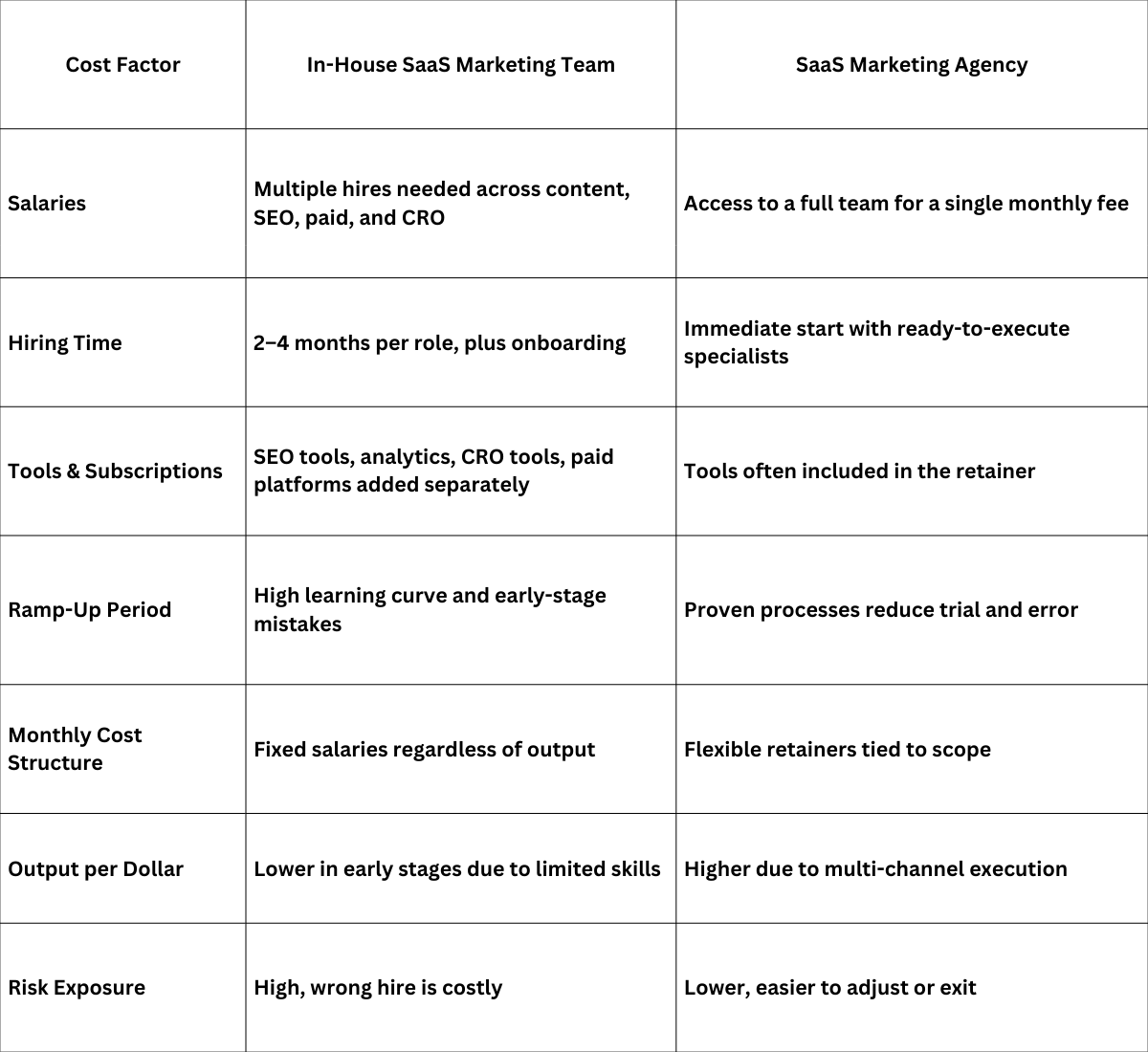
True Cost Comparison: In-House Team vs SaaS Marketing Agency
This comparison highlights a critical reality for SaaS leaders. The decision is not about who looks cheaper on paper, but which option delivers faster execution, broader expertise, and measurable revenue impact with the least financial risk.
Why Agencies Often Cost Less Than One Senior Hire
A single senior SaaS marketer can cost as much as an entire agency retainer, yet still cover only one or two channels. Agencies spread cost across multiple specialists, tools, and processes, making them more efficient for budget-conscious SaaS teams.
Cost alone does not decide the winner. The next factor is how fast each model can drive measurable SaaS growth.
Budget limitations affect not just team structure but how you promote your product. Check out our tips on How to Promote SaaS Content with Paid Ads to see when agency expertise can accelerate paid growth.
Speed to Revenue: Which Option Delivers Faster Results?
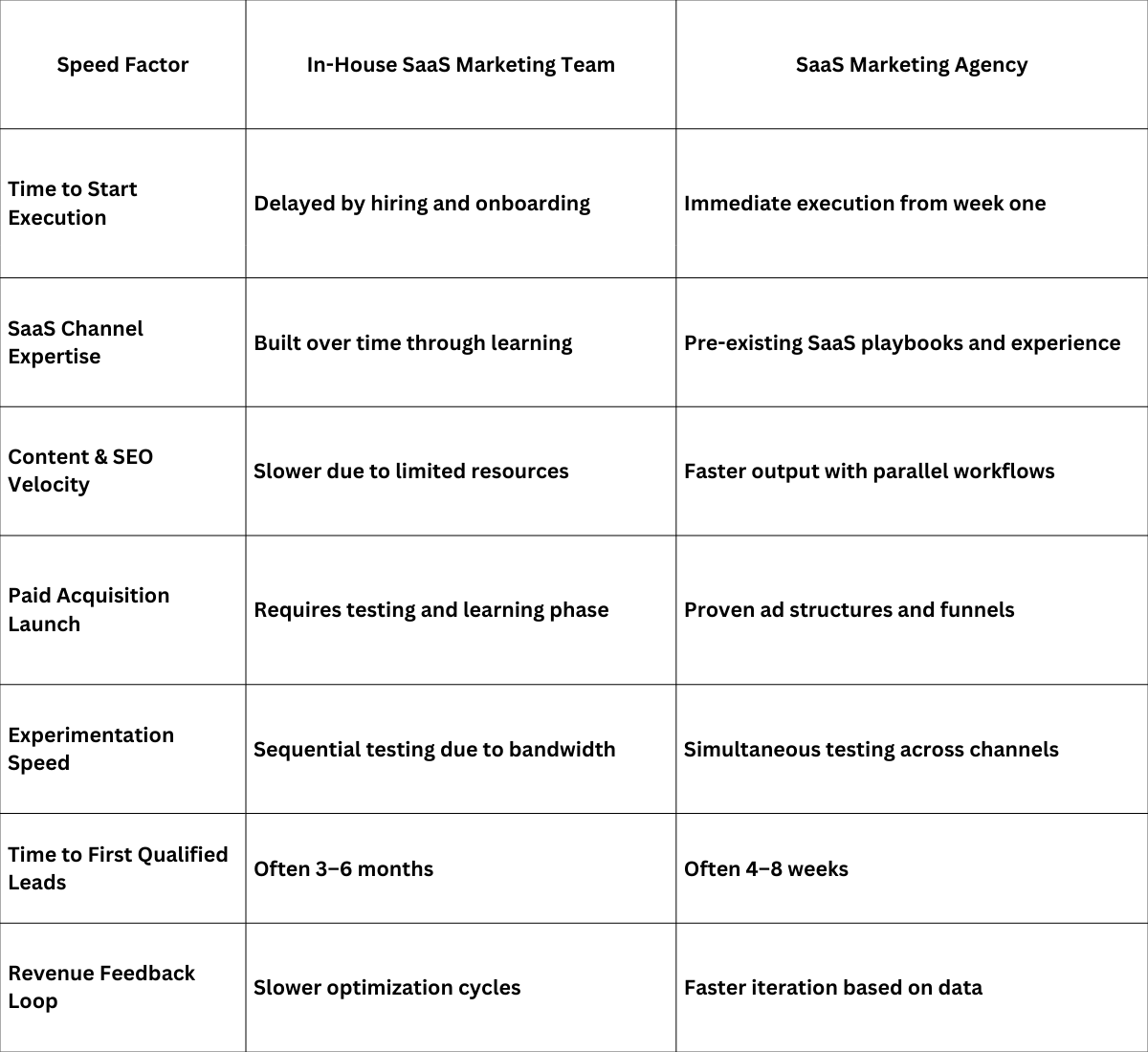
In SaaS, growth is not delayed by ideas. It is delayed by execution speed. When budgets are limited, slow results cost more than any tool or retainer.
Speed alone is not enough. The next decision factor is how well each model manages risk when budgets are tight.
Why Speed Matters More Than Headcount in SaaS
A larger team does not guarantee faster results. What matters is how quickly ideas turn into traffic, leads, and revenue. Delayed execution means delayed learning and delayed growth.
Agency Advantage in Execution Velocity
Agencies operate with tested systems, clear workflows, and cross-functional teams. This allows faster launches, quicker optimizations, and better use of limited budgets.
In-House Team Learning Curve
In-house teams often spend early months learning SaaS-specific channels, tools, and benchmarks. During this time, budget is spent but revenue impact remains limited.
Choosing the right execution model also depends on where your growth is coming from. Understanding the best marketing channels for SaaS in 2026 helps SaaS teams decide whether an agency or in-house team can realistically execute across content, paid, and ABM without slowing revenue.
Expertise Depth: Can One Team Do It All in SaaS?
SaaS marketing is not a single skill set. It is a system of interconnected channels that demand depth, not just effort.
Challenges With Limited In-House Expertise
When budgets are tight, SaaS companies often rely on one or two marketers to handle everything.
Common challenges
- One marketer managing content, SEO, paid ads, CRO, and analytics
- Context switching reduces quality and speed
- Tactical execution without strategic depth
Impact on performance
- SEO lacks technical and content alignment
- Paid campaigns underperform due to weak funnel strategy
- Content drives traffic but not qualified leads
This is where agencies differentiate themselves through specialized SaaS experience.
How to Assess Agency Expertise in SaaS Marketing
Not all agencies understand SaaS so evaluating expertise correctly is critical for your SaaS growth.
Key indicators of strong SaaS expertise
- Proven SaaS case studies with measurable results
- Clear understanding of buyer journeys and funnel stages
- Experience with long sales cycles and MRR-driven KPIs
- Ability to align content, SEO, paid, and CRO toward revenue
What to look for?
- Focus on pipeline and demos, not just traffic
- Familiarity with product-led and sales-led growth models
Beyond expertise, flexibility becomes a major advantage when budgets are limited.
Flexibility and Scalability With Limited Budgets
SaaS growth rarely follows a straight line. Marketing execution must adapt quickly.
Agency-led flexibility
- Scale campaigns without hiring new roles
- Pause or reduce spend without long-term commitments
- Reallocate budget toward channels that perform
Why agencies reduce long-term risk
- No dependency on a single hire
- Easier course correction when strategies fail
- Lower sunk cost during experimentation phases
With expertise and flexibility covered, the final decision comes down to choosing the right partner for your SaaS stage and budget reality.
The ability to execute high-impact assets like case studies often determines whether an in-house team or a SaaS marketing agency delivers real revenue results, as explained in How to Use Case Studies in SaaS Content Marketing.
Communication and Alignment: Agency vs In-House
For SaaS teams deciding which is best between SaaS marketing agency and in-house team, alignment often determines success more than talent.
How Often Should SaaS Companies Communicate With Marketing Agencies
Clear communication rhythms help agencies act as an extension of your team rather than an external vendor.
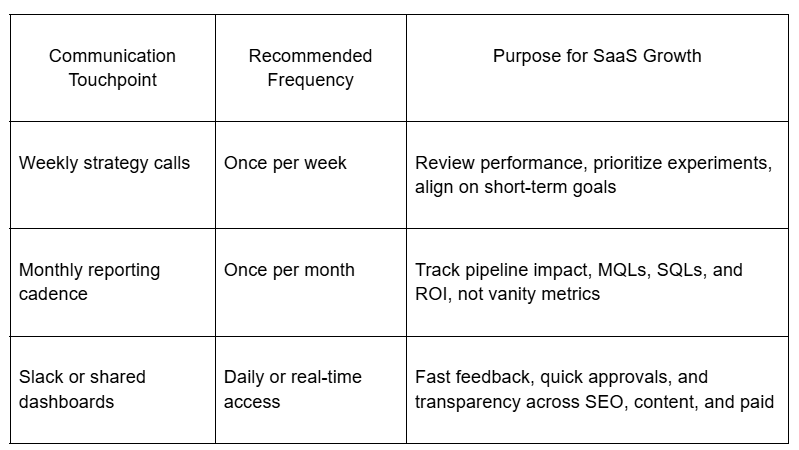
When communication is structured, agencies move faster and stay aligned with revenue goals. Further, poor communication is a hidden cost many SaaS teams overlook when choosing between an agency and in-house team.
Common breakdowns
- Misaligned KPIs between marketing and revenue teams
- Overfocus on traffic, impressions, or clicks
- Lack of clarity on buyer stage and funnel priorities
Vanity metrics vs pipeline metrics
- Vanity metrics show activity, not growth
- Pipeline metrics connect content, SEO, and paid efforts to demos and revenue
When SaaS companies understand how often SaaS companies should communicate with marketing agencies, agency partnerships outperform in-house teams by staying focused on measurable outcomes rather than surface-level wins.
When budgets are tight, choosing between a SaaS marketing agency or an in-house team becomes critical, especially when you need to quickly fix issues like a drop in leads, as explained in How to Diagnose a Drop in Leads for SaaS your Company.
How to Choose a Marketing Agency for B2B SaaS
Choosing the right partner is critical when deciding which is best between SaaS marketing agency and in-house team, especially with limited budgets. The wrong agency can drain resources without delivering revenue impact.
What to Look for When Hiring a SaaS Marketing Agency
A strong SaaS agency thinks beyond execution and focuses on business outcomes.
Key criteria to evaluate
- SaaS-first mindset with experience in B2B SaaS growth models
- Revenue-driven reporting that tracks MQLs, SQLs, demos, and pipeline contribution
- Channel clarity, not buzzwords, across content, SEO services, paid acquisition, and CRO
- Clear answers on how to assess agency expertise in SaaS marketing using real examples
Smart questions to ask
- How do you align marketing with long sales cycles and MRR goals?
- How do you prioritize channels when budgets are limited?
Startups have additional constraints that make agency selection even more important.
How to Choose a Marketing Agency for a SaaS Startup
Early-stage SaaS companies need focus, speed, and flexibility, not generic marketing promises. A strong foundation starts with a clear SEO audit to identify quick wins, technical gaps, and high-intent opportunities before scaling content, paid campaigns, and lead generation efforts.
What to avoid
- Generic digital marketing agencies without SaaS experience
- Agencies that promise traffic without pipeline accountability
What to prioritize
- Proven experience with both early-stage and scale-stage SaaS companies
- Understanding of budget-efficient growth channels
- Clear guidance on how to choose a marketing agency for SaaS startup goals
By focusing on these factors, SaaS leaders can confidently decide which is best between SaaS marketing agency and in-house team based on revenue impact, not assumptions.
Strong SaaS thought leadership content often decides whether an in-house team or a SaaS marketing agency can generate long-term trust and revenue.
When an In-House Team Makes More Sense vs When a SaaS Marketing Agency Is the Better Choice
There is no universal winner. The right choice depends on stage, budget maturity, and growth pressure.
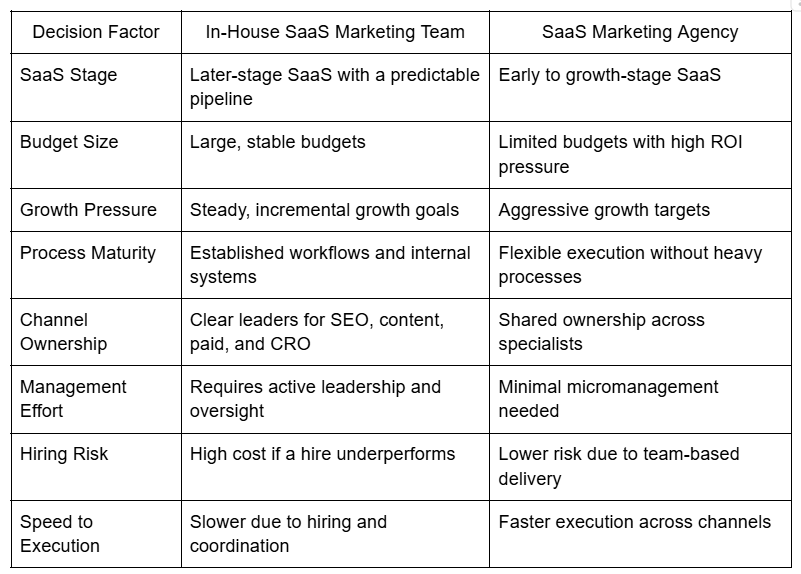
In-house teams make sense when systems, budgets, and leadership are already in place. SaaS marketing agencies are often the better choice when speed, flexibility, cross-channel execution, and SaaS SEO expertise matter more than internal ownership.
With these scenarios clear, the final step is making a confident decision that aligns marketing spend directly with revenue goals.
Final Verdict: Which Is Best Between SaaS Marketing Agency and In-House Team?
The short answer to which is best between SaaS marketing agency and in-house team is this: it depends on your growth stage and budget reality. There is no one-size-fits-all solution, but there is a right choice for your current constraints.
For SaaS companies with limited budgets, marketing agencies consistently offer faster ROI and lower risk. Instead of betting on individual hires, you gain immediate access to SEO, content, paid acquisition, and CRO expertise, all aligned toward revenue outcomes. This reduces experimentation costs and shortens the path to qualified leads.
Ultimately, this decision should be tied to revenue impact, not team size or internal preferences. The winning model is the one that turns marketing spend into pipeline growth predictably. For most budget-conscious SaaS teams, that makes a SaaS marketing agency the smarter growth partner.