


How to Build Thought Leadership Through Content Marketing in SaaS That Drives Trust and Growth
SaaS buyers do not trust ads. They trust expertise.
Before booking a demo, most decision-makers:
- Research their problem
- Compare multiple solutions
- Follow brands that consistently educate them
This is why thought leadership is no longer optional. It is a growth lever.
If your SaaS content is not shaping how buyers think, it is not influencing buying decisions.
Thought leadership content builds credibility long before a sales call happens. It positions your SaaS brand as a problem-solver, not just another tool in a crowded market. Instead of chasing attention, you earn trust by sharing insights, frameworks, and real-world experience that help buyers make better decisions.
In competitive SaaS categories, features can be copied and pricing can be matched. Authority cannot. When your content demonstrates deep industry understanding, it differentiates your product, shortens sales cycles, and turns content into a long-term trust engine that fuels sustainable growth.
What Thought Leadership Content Means in SaaS (And What It Is Not)
SaaS thought leadership is not promotional content or feature marketing. It is opinion-led insight backed by data, real experience, and market understanding, supported by strong SaaS SEO to ensure those insights reach the right audience. True thought leadership teaches buyers how to think about their problems, trends, and decisions rather than pushing what to buy. It is future-focused, problem-aware, and designed to shape perspectives and search intent long before purchase intent even forms.
Common Myths That Kill SaaS Thought Leadership
To move beyond these myths, SaaS brands must understand what truly drives authority and trust and that starts with a clear strategy for creating insight-led, buyer-focused content.
- Thought leadership is not limited to brand storytelling without data, expertise, or original perspective.
- It is not promotional content or generic SEO blogs that focus only on features and keywords.
- Posting content frequently without a clear strategy does not build authority or trust.
- Failing to plan a thought leadership content calendar for SaaS leads to inconsistent messaging and weak positioning.
- True SaaS thought leadership requires structured, insight-led content aligned with buyer problems and market trends.
How Thought Leadership Content Builds Brand Awareness, Trust, and Authority in SaaS
Thought leadership content works because it earns attention before buyers are ready to buy. Instead of chasing demand, it creates it.
What Brands You Know Emerged Due to Thought Leadership
Real SaaS Founder Examples That Prove Thought Leadership Works
- Neil Patel built trust long before selling tools by consistently sharing SEO insights, frameworks, and data-driven opinions. That thought leadership directly translated into credibility and adoption for Ubersuggest, even in a competitive SEO market.
- Dharmesh Shah used consistent thought leadership around inbound marketing to establish HubSpot as a trusted B2B SaaS brand before prospects ever spoke to sales.
- Des Traynor built authority by openly sharing product, growth, and customer communication insights. His thought leadership positioned Intercom as a category leader focused on customer-first SaaS, not just messaging features.
- Patrick Campbell earned deep trust by educating SaaS founders on pricing and monetization long before selling software. That expertise directly fueled adoption and credibility for ProfitWell.
Content continues to play a major role in influencing buying decisions before users speak to sales. According to the HubSpot State of Marketing report, marketers are increasingly investing in content strategies that focus on education, engagement, and long-term audience building. This is exactly how thought leadership content drives brand awareness in SaaS while building long-term trust and authority.
Key benefits of thought leadership content for SaaS companies include:
- Builds strong top-of-funnel visibility among SaaS decision-makers
- Improves brand recall before demos, trials, and evaluations
- Positions your SaaS as a category authority, not just a feature-based tool
- Increases branded search growth and referral traffic
- Creates higher trust before sales conversations begin
- Improves lead quality and shortens sales cycles
- Generates stronger inbound demand over time
- Supports customer retention and brand advocacy
- Increases long-term brand equity and company valuation
When executed consistently, thought leadership becomes a scalable growth asset rather than a one-time content effort.
Need help? Book a call with us.
How Content Differentiates SaaS in a Crowded Market
Most SaaS products solve similar problems, offer comparable integrations, and compete on price. Buyers no longer choose the tool with the longest feature list. They choose brands they understand, trust, and remember. This is how content differentiates SaaS in a crowded market, especially when product parity is high.
Why features no longer win alone:
- Most SaaS tools address the same core pain points
- Feature comparisons create confusion, not clarity
- Trust and understanding influence buying decisions more than specs
Differentiation Through Perspective and Thought Leadership:
- Clear frameworks and mental models that help buyers think differently
- Original data, benchmarks, and market insights that competitors cannot copy
- Strong positioning focused on one core problem your SaaS owns
- Consistent publishing that reinforces authority and visibility over time
For thought leadership strategies for new SaaS startups, consistency matters as much as insight. The importance of consistency in content publishing for SaaS thought leadership lies in repetition, credibility, and long-term recall. Brands that show up with clarity and conviction win mindshare before they ever compete on features.
Don’t let your SaaS fall behind. Discover the content trends shaping buyer expectations and how to use SaaS SEO to stay relevant and ahead of competitors.
How to Build Authoritative Content for SaaS Thought Leadership
Authoritative content is what separates visible SaaS brands from trusted ones. It is not about publishing more, but about publishing with depth, conviction, and relevance. This is how to build authoritative content for SaaS thought leadership and how content differentiates SaaS in a crowded market where surface-level blogs no longer work.
Pillars of Authority Content
- First-hand insights from real SaaS growth stages, wins, and failures
- Data-backed opinions instead of recycled or generic content
- A clear stance on industry trends, common mistakes, and future direction
Content Types That Build Authority Fast
To build authoritative content for SaaS thought leadership, brands must prioritize formats that educate, guide decisions, and demonstrate real-world expertise.
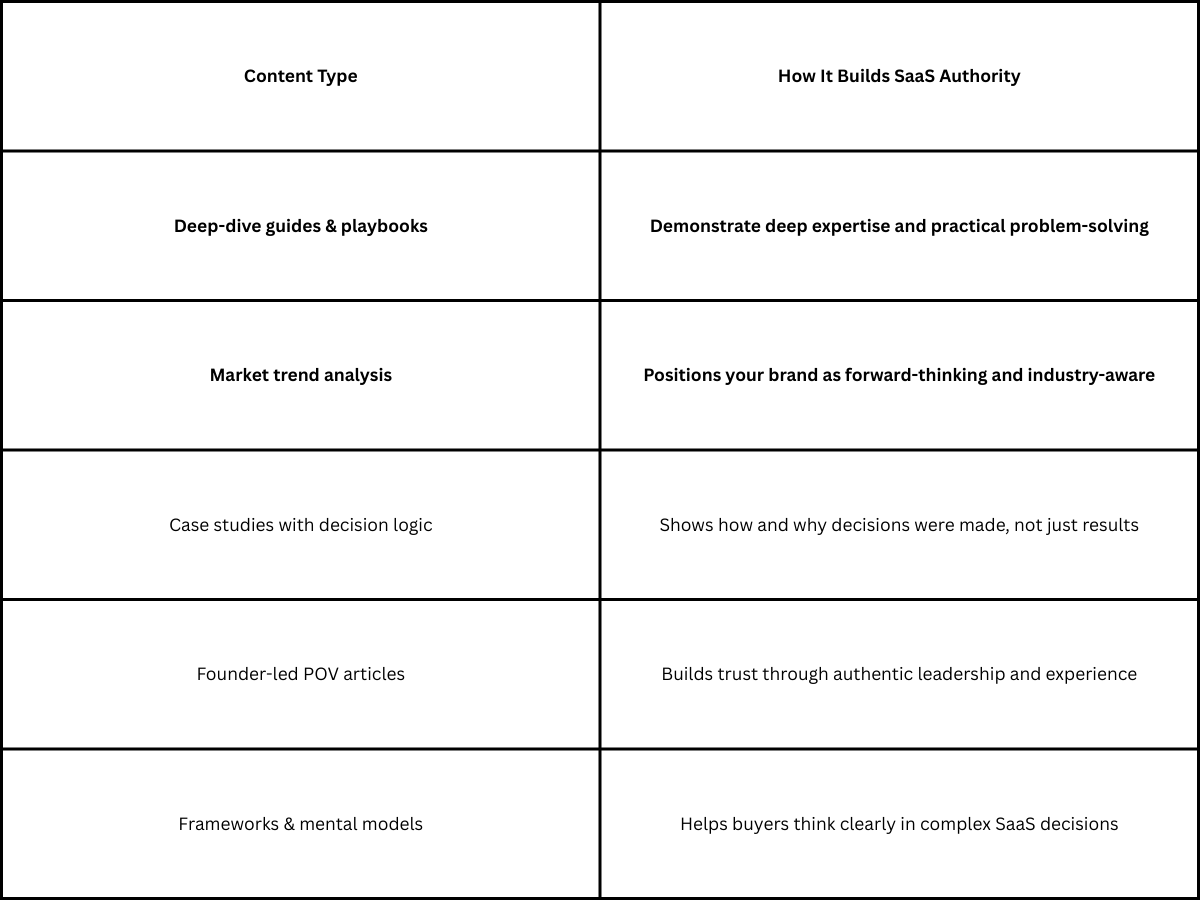
When done right, these formats reinforce how to build authoritative content for SaaS thought leadership while consistently proving why your SaaS deserves attention in a crowded market.
Struggling to publish content consistently or turn blogs into real SaaS growth? A strategic editorial calendar is the missing system that transforms scattered ideas into predictable traffic, leads, and authority.
Thought Leadership Strategies for New SaaS Startups
For early-stage SaaS companies, thought leadership is not about being everywhere. It is about being unmistakably clear. Strong positioning early on unlocks long-term visibility, trust, and demand. These thought leadership strategies for new SaaS startups help build authority without burning resources and highlight the long-term benefits of thought leadership content for SaaS companies.
If you are an early-stage SaaS:
- Own one narrow, high-impact problem before expanding your narrative
- Focus on educating buyers about the problem and decision process, not the product
- Publish fewer pieces, but make them deeper, sharper, and insight-driven
- Build clarity first, scale content later
Smart channels for new SaaS thought leadership:
- SEO-driven long-form blogs that answer complex buyer questions
- LinkedIn founder-led content to humanize expertise and vision
- Guest posts on niche SaaS and industry platforms
- Repurpose core blogs into carousels, threads, and short-form insights
To sustain momentum, startups must plan a thought leadership content calendar for SaaS that prioritizes consistency, depth, and strategic distribution rather than volume. This approach compounds trust and authority over time.
How to Plan a Thought Leadership Content Calendar for SaaS
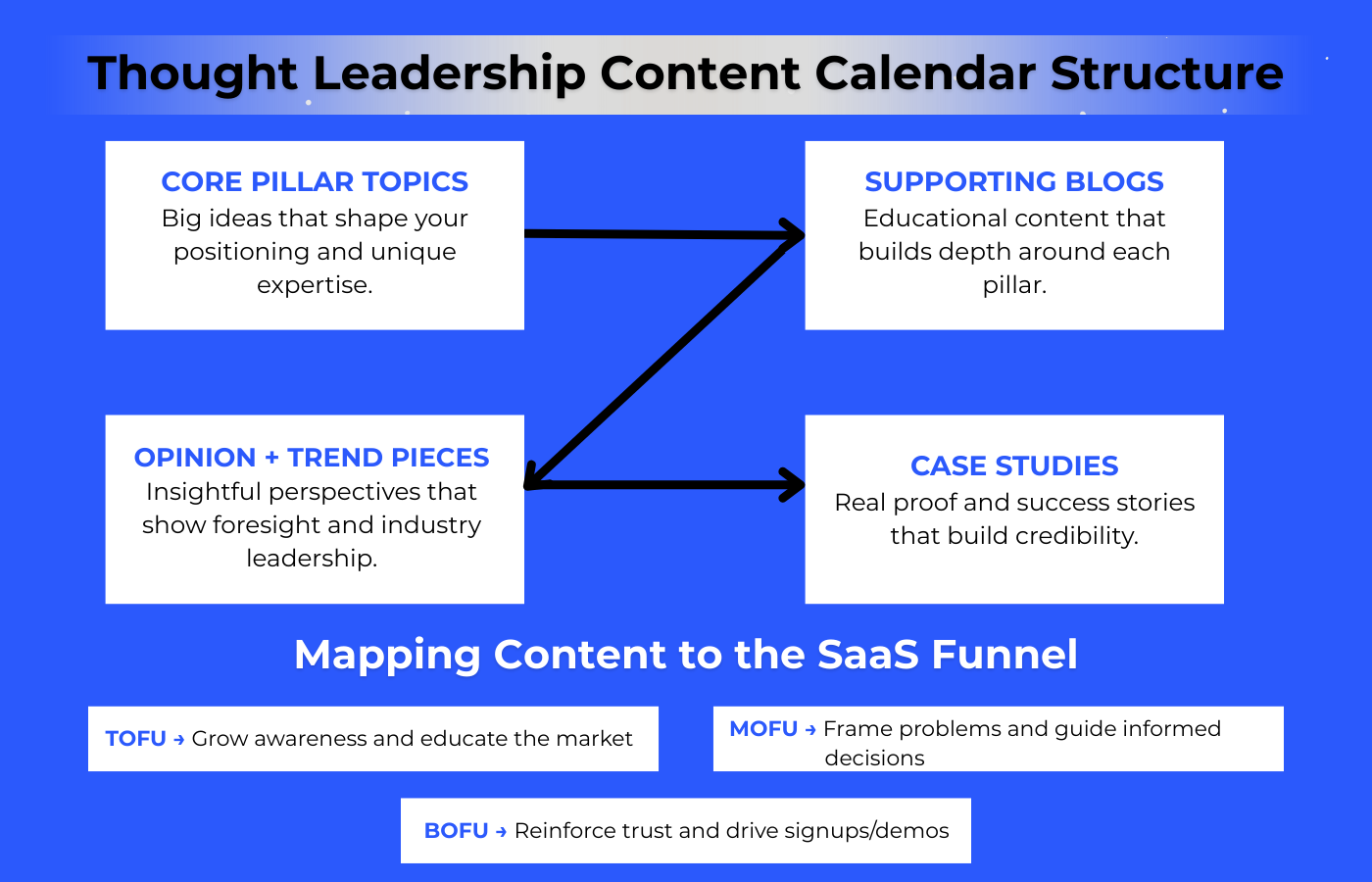
A strong calendar turns ideas into authority. To plan a thought leadership content calendar for SaaS, you need structure, intent alignment, and consistency. This ensures your content builds trust over time instead of feeling scattered.
Thought leadership calendar structure:
- Core pillar topics that define your big ideas and positioning
- Supporting blogs that educate and add depth around each pillar
- Opinion pieces and trend commentary to show perspective and foresight
- Case studies that validate expertise with real-world outcomes
Mapping content to the SaaS funnel:
- TOFU: Market education and awareness-driven insights
- MOFU: Problem framing, comparisons, and decision guidance
- BOFU: Authority proof, credibility, and trust reinforcement
When planned correctly, this structure supports consistent publishing and compounds the impact of SaaS thought leadership content across the entire buyer journey.
How Radian Marketing Can Help?
Building authority in SaaS requires more than publishing content. It requires a system that connects insight, SEO, and buyer intent. This is how to build thought leadership through content marketing in SaaS in a way that drives trust, demand, and measurable growth.
What Makes Radian Marketing Different
- SaaS-specific content frameworks built around real buying behavior
- SEO-driven thought leadership, not generic blogs written for traffic alone
- Funnel-aligned authority content that supports TOFU, MOFU, and BOFU goal
- Founder-led and product-led positioning to humanize expertise and vision
Our approach focuses on how thought leadership content drives brand awareness in SaaS while reinforcing how content differentiates SaaS in a crowded market. Here’s how we do it:
- In-depth market, competitor, and ICP research
- Authority topic clustering to build topical depth and trust
- A structured plan to plan a thought leadership content calendar for SaaS with SEO and conversion intent
- Consistent publishing, optimization, and multi-channel distribution
This process ensures the importance of consistency in content publishing for SaaS thought leadership while helping brands build authoritative content for SaaS thought leadership that compounds over time.
Conclusion: Turning SaaS Content Into a Scalable Authority Engine
Thought leadership is not a branding exercise. It is a revenue strategy.
When done right, it:
- Builds trust before sales conversations
- Improves lead quality
- Shortens buying cycles
- Creates long-term competitive advantage
SaaS brands that invest in insight-driven content win attention, trust, and demand before competitors even enter the conversation.
The long-term benefits of thought leadership content for SaaS companies include higher-quality leads, shorter sales cycles, stronger inbound demand, and lasting brand equity. This is exactly how to build thought leadership through content marketing in SaaS to move beyond visibility and create real business impact. Partnering with a SaaS-focused content marketing agency for SaaS thought leadership ensures your strategy drives measurable growth, authority, and trust, not just traffic.