


How To Create Customer Personas For SaaS Content Strategy To Avoid Wrong Traffic
Is your SaaS content failing because it attracts the wrong audience? Generic blogs may drive traffic, impressions, and even engagement, but they rarely move the pipeline. This is exactly why learning how to create customer personas for SaaS content strategy matters. A clear buyer persona for SaaS helps you align content with real decision makers, real pain points, and real buying intent.
The promise of persona-driven content is simple: less wasted traffic, more qualified leads, and content that supports revenue instead of just rankings.
What Is a Buyer Persona in SaaS Marketing?
A buyer persona for SaaS is a detailed, research-based profile of the decision maker or influencer involved in purchasing your SaaS product. It represents who you are creating content for, including their role, responsibilities, goals, pain points, buying triggers, objections, and decision criteria. In simple terms, a buyer persona helps you understand why someone buys, not just who they are.
In SaaS marketing, buyer personas guide everything from content topics and SEO keywords to CTAs, landing pages, CRO, and sales enablement assets. When you know why should you create customer personas, the answer becomes clear: they prevent wrong traffic and ensure your content attracts users with real purchase intent.
A well-defined customer persona for SaaS typically includes:
- Job role and seniority (e.g., Head of Marketing, SaaS Founder)
- Core business challenges and KPIs
- Content consumption behavior
- Buying objections and evaluation process
Customer Persona vs User Persona in SaaS
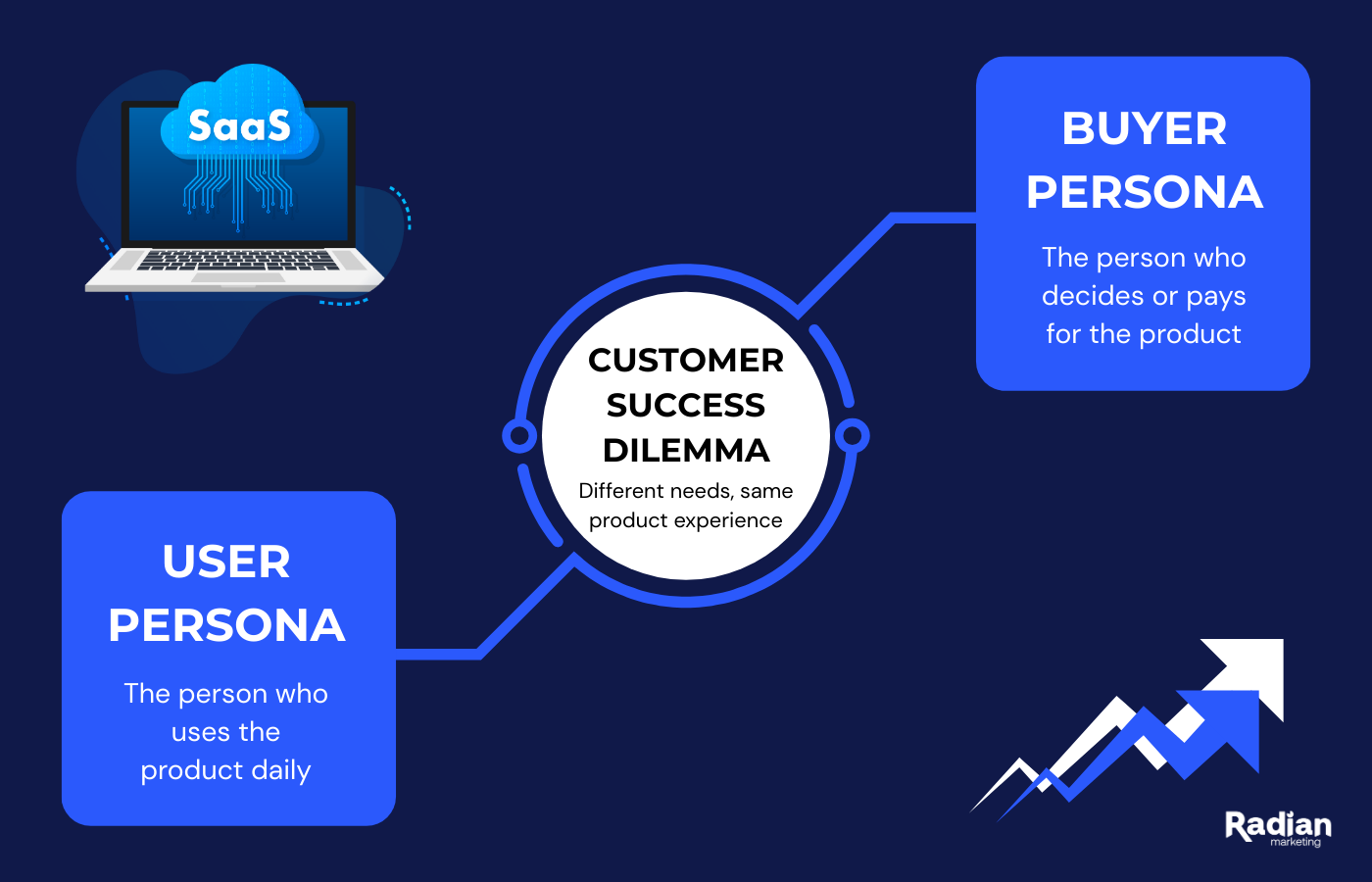
The difference between customer persona vs user persona is critical in SaaS content strategy.
- Customer (Buyer) Persona: Focuses on the person who decides or pays for the software. Content targets ROI, scalability, security, and business outcomes.
- User Persona: Represents the end user who uses the product daily. Content focuses on usability, features, workflows, and efficiency.
High-performing SaaS content strategies prioritize buyer personas for demand generation and pipeline growth, while user personas support product adoption and retention.
Why Should You Create Customer Personas Before Scaling Content?
You should create customer personas for SaaS growth because scaling content without them amplifies the wrong traffic, not revenue. Without a clear buyer persona for SaaS, teams invest in SEO and ads that attract readers who will never convert.
The cost of not using personas in content strategy is wasted ad spend, low-quality leads, and content that inflates vanity metrics instead of pipeline. Persona-driven content fixes this by aligning keywords, topics, and CTAs with real buying intent, reducing wasted SEO effort and improving conversion efficiency.
The Role of Customer Personas in SaaS Content Strategy
Customer personas act as the blueprint for your entire SaaS content strategy. They ensure every topic, headline, and CTA is created with a specific buyer in mind, not a broad audience. When personas are clearly defined, content naturally aligns with the right funnel stage and mirrors real sales conversations, making it easier to turn traffic into qualified leads.
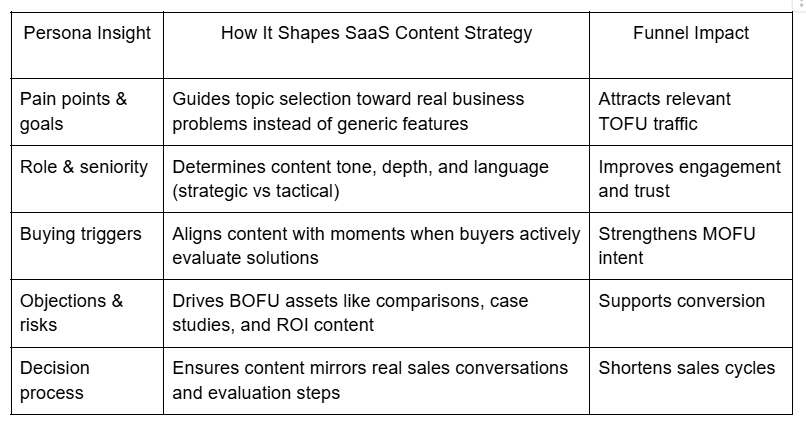
By mapping buyer personas to TOFU, MOFU, and BOFU content, SaaS teams avoid creating disconnected blogs and instead build content that naturally supports sales conversations. This is how persona-driven content turns SEO traffic into a qualified pipeline, not just pageviews.
For the latest insights on where your SaaS personas are most active, check out our guide to the best marketing channels for SaaS.
Step-by-Step: How To Create Customer Personas For SaaS Content Strategy
Creating personas for SaaS content is not a branding exercise. It is a revenue alignment process. Below is a practical, SEO-driven framework on how to create customer personas for SaaS content strategy that actually prevents wrong traffic and improves conversions.
Step 1: Start With Revenue, Not Demographics
In SaaS, two people with the same job title can have very different buying power. A “Marketing Manager” in a startup may execute tools, while in an enterprise they influence decisions but do not own the budget. This is why demographics alone fail.
Instead, focus on:
- Core responsibilities tied to revenue
- Decision-making authority
- Budget ownership and approval influence
For instance, if you are an EdTech SaaS attracting universities or training institutes, the person engaging with your content may not be the actual buyer. While a “Head of Academics” or program manager uses the platform daily, they rarely control the purchase decision.
In most cases, the real buyer persona is the COO or Founder who evaluates the tool based on student outcomes, retention, operational scalability, and long-term ROI.
Step 2: Analyze High-Intent Data Sources
The most accurate buyer persona for SaaS is built from conversion data, not assumptions.
Key data sources:
- CRM and sales call insights: Objections, deal blockers, common questions
- Demo requests and closed-won data: Roles that actually convert
- Google Search Console queries: Keywords that lead to demos, not just clicks
For instance, if you are a FinTech SaaS targeting mid market or enterprise businesses, not every visitor searching finance terms is a potential buyer. Real buyer personas emerge from users who move beyond education and into evaluation.
In this case, queries like “payment gateway for subscription businesses” or “compliance ready fintech API for enterprises” convert far better than broad searches like “what is a payment gateway,” clearly signaling buyer intent and persona maturity.
Step 3: Identify Content Consumption Behavior
Different customer segments expect different content formats and depth.
Map each persona by:
- Preferred formats (blogs, case studies, comparison pages, webinars)
- Trusted channels (search, LinkedIn, industry communities)
- Content depth expectations based on role and seniority
For instance, if you are a Cybersecurity SaaS selling to mid market or enterprise teams, content consumption behavior varies sharply by role and seniority.
In this case, CISOs and founders look for risk reduction, compliance, and ROI focused content such as case studies and vendor comparisons, while security managers prefer technical guides, implementation checklists, and integration documentation. This highlights the benefits of personalizing content for customer segments in SaaS to attract buyers at different decision levels.
Step 4: Define Pain Points, Objections, and Triggers
Strong personas distinguish between:
- Operational pain: Manual reporting, poor adoption, integrations
- Strategic pain: Scaling enrollment, retention, long sales cycles
Also document:
- Objections that delay buying (pricing, security, migration effort)
- Trigger events (accreditation changes, growth phase, churn spikes)
For example, if you are an HR Tech SaaS, operational pain includes manual HR processes and poor integrations, while strategic pain focuses on scaling teams and compliance risk. Objections like pricing and migration delays buying, and trigger events such as rapid hiring or policy changes drive active searches for HR automation tools.
Step 5: Document Persona Content Expectations
Each persona expects specific proof and language from your content.
Define:
- Questions they expect SaaS content to answer
- Metrics they trust (ROI, adoption rate, compliance impact)
- Proof formats (case studies, benchmarks, comparisons)
This is where persona-focused blog topics for SaaS buyers in marketing roles and decision-makers are finalized, ensuring your content attracts buyers, not browsers.
For example, in a Marketing Tech SaaS, CMOs expect ROI and pipeline impact, while demand gen managers want execution metrics and integrations. Case studies and benchmarks build trust and ensure content attracts buyers, not browsers.
When done right, this process explains why you should create customer personas before scaling SEO or paid campaigns. Personas ensure every blog, landing page, and ad aligns with buying intent and supports pipeline growth, not just traffic.
Want to boost persona-driven content with paid traffic that converts? See how to promote SaaS content with paid ads.
Core SaaS Buyer Personas You Should Build Content For
Building content without clear buyer personas is one of the fastest ways SaaS teams attract the wrong traffic. Below is a practical table outlining the core buyer persona for SaaS, what each role cares about, and the type of content they actively search for before making decisions.
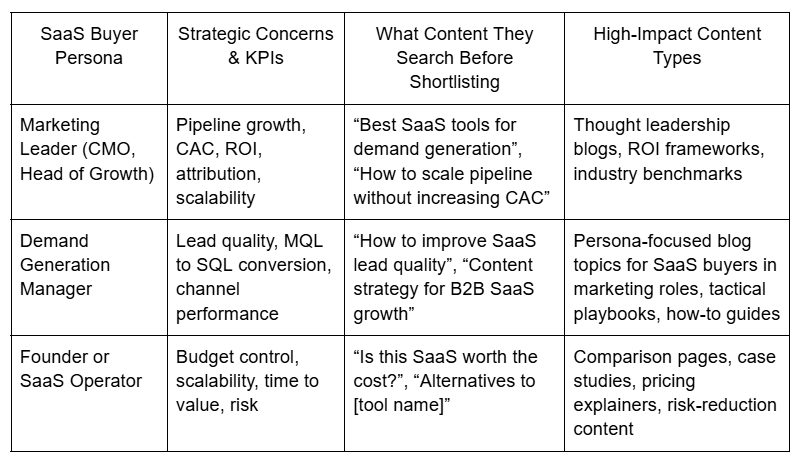
This persona-based breakdown highlights the benefits of personalizing content for customer segments in SaaS. Each persona consumes content differently, and aligning topics with their concerns ensures your SEO and content strategy drives qualified leads instead of surface-level traffic.
To build trust and reduce buyer hesitation, learn how to use case studies in SaaS content marketing to validate outcomes and support purchase decisions.
How to Turn Customer Personas Into High-Intent Content Topics
High-intent SaaS content begins by mapping persona pain points to search behavior, not generic keywords. Each buyer persona for SaaS searches differently based on responsibility, urgency, and buying stage.
Use persona-based keyword clustering to:
- Translate real pains into commercial and transactional keywords
- Group keywords by role, funnel stage, and intent
- Create focused pages that answer buying questions
This approach explains how to create customer personas for SaaS content strategy that avoids wasted effort. By filtering out broad informational queries, you prevent low-quality traffic and build content that attracts buyers actively evaluating solutions.
To turn your SaaS customer personas into a consistent, high-impact publishing plan, check out our guide on how to create an editorial calendar for SaaS content marketing.
How Radian Marketing Builds Persona-Driven SaaS Content That Converts
Radian Marketing builds SaaS content by connecting buyer personas, SEO intent, and revenue goals from the start. Instead of chasing traffic, each content piece is designed to support pipeline growth.
Radian’s persona-driven approach includes:
- Mapping SaaS buyer personas to commercial and transactional keywords
- Aligning content topics with funnel stages and sales conversations
- Using role-specific frameworks (ROI for CMOs, execution for demand gen, validation for founders)
This approach shows how to create customer personas for SaaS content strategy that avoids wrong traffic and consistently converts qualified visitors into demos and opportunities.
Wondering whether to build your SaaS marketing strategy with an in-house team or partner with experts? Our comparison of SaaS marketing agency vs in-house team shows how persona-driven content and CRO-focused SEO perform best with the right strategy.
Conclusion: Stop Creating Content for Everyone and Start Creating It for Buyers
Creating content for everyone is the fastest way to attract the wrong traffic. Learning how to create customer personas for SaaS content strategy helps filter out low intent users and align every blog, page, and keyword with real buyers. When you understand why should you create customer personas, your SaaS content stops chasing clicks and starts supporting pipeline growth and revenue.
A persona first SaaS content strategy ensures SaaS SEO, paid campaigns, and sales messaging work together, not in silos.
Audit your existing content through a persona lens. Identify which pages attract buyers and which only drive vanity metrics, then rebuild your strategy around personas that convert.