


Homeware is a visual and highly competitive ecommerce category. Customers compare styles, materials, prices, reviews and brands before buying. That makes SEO for homeware brands an important part of building consistent organic visibility and sales.
A beautiful website alone is not enough. Your products need to appear when someone searches for them.
Whether you sell furniture, cushions, tableware, bedding, lighting or home accessories, SEO can help your brand reach shoppers at the right moment.
Here is a practical step-by-step approach to getting started.
Why You Need SEO for Homeware Brands
Homeware shoppers often start with research. They may search for a specific product, explore a room style, compare materials or look for inspiration before making a purchase.
Google’s 2025 India data shows how important search remains for shoppers. 80% of Gen Z relies on Google Search for shopping, discovery, research and decisions, while 87% of Indian consumers surveyed said they discovered a new brand, product or retailer on Google and YouTube.
For a D2C brand, this creates a major opportunity.
A strong organic strategy can help you:
- Reach high-intent shoppers
- Increase product visibility
- Drive relevant organic traffic
- Reduce dependence on paid advertising
- Build brand credibility
- Improve product discovery
- Generate long-term ecommerce growth
Google is also expanding AI-powered shopping and product discovery. In 2024, Google said people shop across Google more than a billion times every day for activities such as product research and shopping.
So, SEO is no longer only about ranking a homepage. Your products, categories, images, content and brand information all need to be discoverable.
Looking for practical ways to bring more shoppers to your ecommerce store? Explore our guide on how to attract customers to an online store for actionable strategies to increase visibility, traffic and conversions.
How to Do SEO for a Homeware D2C Brand
Already have a website?
Skip to Step 2.
Launching a new homeware store?
Start with Step 1.
Step 1: Create an SEO-Friendly Website
Your website is the foundation of your SEO strategy.
If customers cannot navigate it easily, search engines will struggle to understand it too.
Build a user-friendly site
Focus on:
- An SEO-friendly ecommerce theme
- Mobile-friendly design
- Clear navigation
- Logical product categories
- Descriptive URLs
- HTTPS security
- Proper H1, H2 and H3 headings
- Easy product discovery
For example, instead of:
/product/p12345
use a descriptive URL such as:
/cushions/velvet-green-cushion/
Your structure should also reflect how customers shop.
Home Decor → Cushions → Velvet Cushions
This makes the relationship between pages clear for both users and search engines.
Once your website structure is ready, the next step is to make sure Google can properly crawl, understand and index your pages.
Not sure which platform is right for your online store? Check out our guide comparing Shopify vs Square Online Store before you make your choice.
Step 2: Set Up Your Website for Google
Once your website is ready, make sure search engines can find and understand it.
Before moving into keyword research and content, make sure search engines can properly access, understand and index your website.
- Google Search Console: Monitor indexing, search performance, keywords and technical issues.
- Google Analytics: Track organic traffic, user behaviour, engagement and conversions.
- XML Sitemap: Create and submit a sitemap to help Google discover important pages.
- Robots.txt: Control which areas of your website search engine crawlers can access.
- Indexability Checks: Make sure important pages are crawlable and indexable.
- Canonical Tags: Tell Google which version of a page should be treated as the primary URL.
- Structured Data: Add relevant schema markup to help search engines understand your products, reviews, breadcrumbs and other page information.
Submit your sitemap through Google Search Console and monitor which pages are indexed.
For ecommerce stores, pay special attention to product variations, filters and duplicate URLs.
Add relevant schema markup, such as Product, Organization, Breadcrumb and Review schema where appropriate.
Want to build a stronger SEO strategy for your D2C brand? Explore our guide to D2C ecommerce SEO strategy in 2026 for practical ways to improve organic visibility, traffic and sales.
Step 3: Go Beyond Google
Google should be a major part of your strategy, but it should not be the only source of discovery.
Customers can also discover brands through:
- Bing
- Yahoo
- Brave Search
- Google Images
- YouTube
- AI-powered search and shopping tools
Bing Webmaster Tools allows website owners to verify their sites, submit sitemaps and monitor SEO issues. Bing also recommends IndexNow for faster notification of updated URLs.
Yahoo search submissions are also handled through Bing Webmaster Tools.
For a visual category like homeware, this wider discovery ecosystem matters.
Looking to increase online sales for your D2C brand? Explore our guide to D2C ecommerce strategy to increase repeat customers for practical strategies to attract customers, improve conversions and grow your online store.
Step 4: Fix Technical SEO Issues
Technical SEO can make or break homeware ecommerce SEO.
Start with the basics.
Check your mobile experience
Most ecommerce browsing happens across smartphones and other mobile devices. Your website should be easy to browse, filter and purchase from on a small screen.
Improve page speed
Large homeware images can slow down ecommerce websites.
Compress images without compromising visual quality.
Also review:
- Core Web Vitals
- JavaScript
- CSS
- Browser caching
- Third-party scripts
- Server response time
Fix broken pages
Regularly check for:
- 404 errors
- Broken internal links
- Redirect chains
- Duplicate pages
- Incorrect canonical tags
- Indexing problems
A technical SEO audit should be performed regularly as your product catalogue grows.
Wondering how AI-powered shopping is changing ecommerce? Explore our guide to ChatGPT Instant Checkout and AI Shopping to understand what it means for D2C brands and online retailers.
Step 5: Research the Right Keywords
Keyword research is one of the most important parts of SEO for homeware brands.
Do not target only broad keywords such as “home decor.”
Build keyword groups around products, categories, styles, materials, rooms and customer problems.
For example:
|
Category |
Example Keywords |
|
Cushions |
velvet cushions, decorative cushions, sofa cushions |
|
Rugs |
living room rugs, washable rugs, modern rugs |
|
Tableware |
ceramic dinner sets, stoneware plates |
|
Lighting |
table lamps, bedroom lamps, modern floor lamps |
|
Bedding |
cotton duvet covers, luxury bedding |
|
Decor |
wall decor, minimalist home decor |
Also target long-tail keywords.
For example:
“neutral cushions for beige sofa”
is more specific than:
“cushions.”
Long-tail searches can help you reach users who already know what they want.
For example, Kolka, our homeware brand client, conducted keyword research for products such as cushion covers. To increase organic visibility for its home textile products, we can target specific keywords related to quilts, bedspreads, cushion covers and other relevant product categories rather than relying only on broad terms such as “home decor.”
Step 6: Build a Strong Content Strategy
SEO should not stop at product pages.
Create content that answers the questions your customers ask before purchasing.
Build topical authority around your category.
For a homeware brand, topics could include:
- How to Choose Cushions for Your Sofa
- How to Style a Small Living Room
- Best Home Decor Ideas for Minimalist Homes
- How to Choose the Right Rug Size
- How to Style a Dining Table
- Home Decor Trends for 2026
- How to Choose Bedding Materials
Use blog content to support your commercial pages.
For example, a blog about styling a living room can naturally link to your cushion, rug, lighting and decor categories.
Update older content based on Google Search Console queries. If a page is receiving impressions but few clicks, improve its title, description, content and search intent alignment.
Do not publish content simply to hit a word count.
Make every page useful.
Not sure how to set up Google Search Console for your website? Check out our Google Search Console setup guide to learn how to connect, verify and monitor your website’s SEO performance.
Step 7: Optimize Every Important Page
On-page SEO helps search engines understand what each page is about.
Optimize:
- Meta titles
- Meta descriptions
- H1 headings
- H2 and H3 headings
- Product descriptions
- Category copy
- Image alt text
- Internal links
- Breadcrumbs
- Schema markup
For example, a product page should clearly communicate its material, colour, size, design, usage and key benefits.
Avoid stuffing keywords into product descriptions.
Write for shoppers first.
For SEO for home decor brands, this is especially important because customers often search using style, colour, room and material combinations.
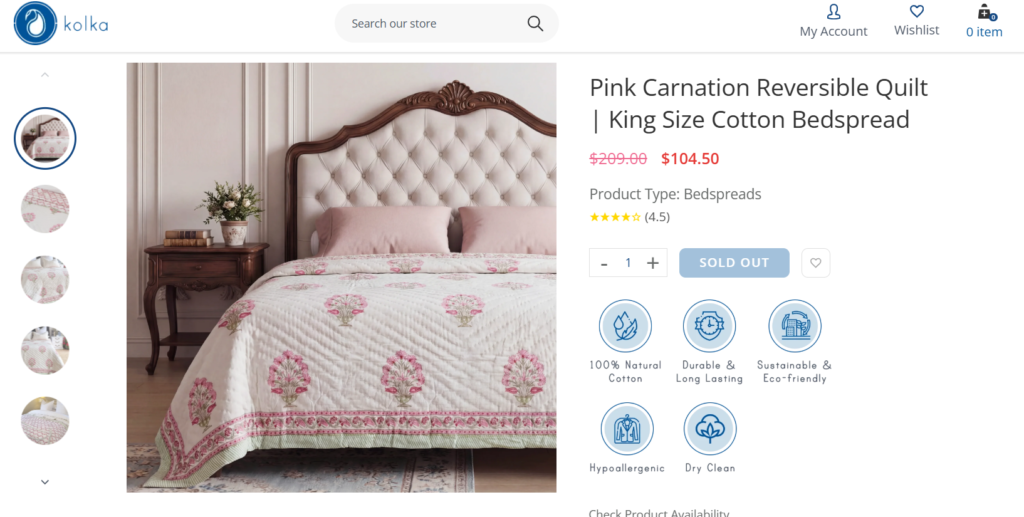
For example, Kolka, our homeware client in Australia, has optimized its product pages by adding multiple product image variants and showcasing product quality and key features. For a product such as the Pink Carnation Reversible Quilt, the page highlights details such as its cotton material, durability, sustainability, hypoallergenic properties and care requirements. This gives shoppers a clearer understanding of the product while providing search engines with useful product information.
Step 8: Build Community and Off-Page Visibility
Homeware is naturally suited to community-driven marketing.
Look for relevant conversations on:
- Facebook Groups
- Quora
- X Communities
- Telegram communities
- Interior design forums
Do not spam links.
Instead, contribute useful ideas.
For example, if someone asks how to style a small bedroom, provide genuinely useful advice. If your guide answers the question in more detail, link to it where appropriate.
This can become a separate content asset while supporting your broader community strategy.
Step 9: Build Relevant Backlinks
Authority still matters.
But homeware brands should focus on relevant links rather than collecting random backlinks.
Consider:
- Interior design websites
- Home decor publications
- Lifestyle blogs
- Architecture websites
- Home improvement websites
- Design magazines
- Relevant business directories
- Guest contributions
- Digital PR
- Influencer collaborations
Product-led PR can work particularly well.
For example, a new sustainable tableware collection could be pitched to relevant lifestyle and sustainability publications.
Want to improve your online store’s organic visibility? Explore our guide on how to do SEO for an ecommerce website for practical strategies to increase rankings, traffic and sales.
Step 10: Track SEO Performance
SEO needs measurement.
Use Google Analytics and Google Search Console to monitor:
- Organic traffic
- Organic conversions
- Revenue from organic search
- Keyword rankings
- Click-through rate
- Product page traffic
- Category page traffic
- Referral traffic
- Conversion rate
- Engagement
- Indexed pages
Do not judge SEO only by rankings.
A keyword ranking at position three means little if it generates no relevant traffic or sales.
The real goal is qualified traffic that contributes to revenue.
Step 11: Optimize for Voice Search and AEO
Search is becoming more conversational.
Customers may ask:
- What size rug should I buy for my living room?
- Which material is best for sofa cushions?
- How do I style a small bedroom?
- What are the best home decor ideas for renters?
Create clear answers to these questions.
Use:
- Conversational keywords
- Question-based headings
- Short answers
- FAQs
- Product information
- How-to content
- Organization schema
- Product schema
- Review schema where appropriate
This also supports Answer Engine Optimization.
AI-driven shopping is becoming more relevant too. Reuters reported in August 2026 that retailers are adapting their content and product information for AI-driven shopping discovery, with Adobe Analytics showing AI referrals generating 41% more revenue per visit than traditional channels in its cited data.
The takeaway is simple: make your product information accurate, useful and easy for machines and humans to understand.
Cheatsheet of SEO Activities
|
SEO Activity |
Frequency |
|
User & mobile-friendly site |
One time |
|
Plan website structure |
One time |
|
Descriptive URL structure |
One time |
|
Install SEO plugin, if applicable |
One time + monitor monthly |
|
HTTPS |
One time |
|
Google Search Console |
One time |
|
Google Analytics |
One time |
|
Create & submit sitemap |
One time |
|
Check page indexing |
Weekly |
|
Schema markup |
One time + update when needed |
|
Check broken links |
Weekly |
|
On-page SEO audit |
Monthly |
|
Technical SEO audit |
Quarterly / as needed |
|
Keyword research |
Weekly / monthly |
|
Image optimization |
Ongoing |
|
Check GSC queries |
Monthly |
|
Publish relevant content |
Weekly / biweekly |
|
Update older content |
Monthly |
|
Google Business Profile |
One time, if applicable |
|
Monitor organic traffic |
Monthly |
|
Optimize meta tags |
Monthly |
|
Voice SEO & AEO |
Monthly |
|
Niche directory listings |
Monthly |
|
Relevant guest posts |
Ongoing |
|
Blogger/influencer collaborations |
Monthly |
What Things Should You Avoid?
SEO mistakes can waste both time and budget.
Avoid:
- Ignoring mobile UX
- Slow-loading product pages
- Keyword stuffing
- Duplicate product descriptions
- Thin category pages
- Poor internal linking
- Spammy backlinks
- Publishing low-value AI content at scale
- Keyword cannibalization
- Ignoring product image SEO
- Creating unnecessary filter URLs
- Measuring success only through rankings
Your SEO strategy should always support the customer journey.
Looking to attract more travellers through organic search? Explore our SEO guide for travel companies to discover practical strategies for improving visibility, traffic and bookings.
What Search Engines Are Beneficial for Homeware Brands?
Google should remain a priority. But it is not the only discovery platform worth considering.
Bing can provide additional search visibility and has dedicated webmaster tools for SEO monitoring. Yahoo search relies on Bing’s index, making Bing optimization relevant for Yahoo visibility too.
Brave Search is another independent search engine with its own search experience and growing visibility-conscious audience.
For homeware, also think beyond traditional search.
Google Images, Pinterest, YouTube and AI-powered shopping discovery can all influence how customers find products.
This is why modern home decor ecommerce marketing should combine search, content, visual discovery and conversion optimization.
How Radian Marketing Helps Homeware D2C Brands
Choosing the best SEO agency for homeware brands is not just about finding an agency that can improve rankings.
You need a partner that understands ecommerce.
At Radian Marketing, our approach connects SEO with the wider D2C customer journey.
Our ecommerce marketing services cover SEO, paid advertising, content marketing, social media, CRO, email marketing and analytics.
We can help with:
- Ecommerce SEO
- Keyword research
- Technical SEO
- Product page optimization
- Content strategy
- Internal linking
- Link building
- Conversion rate optimization
- Ecommerce PPC
- Social media advertising
- Performance analytics
If you are comparing the best marketing agency for home decor brands, look beyond promises of rankings. Choose a team that understands how traffic becomes revenue.
For brands looking for a digital marketing agency for homeware brands, the right strategy should combine organic search with paid, social, content and conversion optimization.
And if your immediate priority is organic growth, working with an experienced ecommerce SEO agency for home decor can help you build the technical and content foundation needed to compete.
Conclusion
SEO for a homeware D2C brand is not about adding keywords to product pages and waiting for rankings.
It starts with a strong website.
Then comes technical SEO, keyword research, useful content, product optimization, internal linking, authority building and continuous measurement.
The biggest opportunity is to connect all these activities.
A customer might discover your brand through Google, explore your Instagram profile, read a buying guide, visit a product page and finally purchase through your website.
Your marketing strategy needs to support every stage.
With the right homeware ecommerce SEO strategy, your website can attract shoppers who are already searching for the products and styles you sell.
The goal is not simply more traffic.
It is more relevant traffic, better customer experiences and more ecommerce revenue.