


If you’ve been selling on Amazon for any length of time, you’ve probably heard the phrase that reviews can make or break a product listing. And you’re right, they absolutely can. In a marketplace as competitive as Amazon, authentic customer feedback is one of the most powerful conversion drivers you have. That’s exactly why the Amazon Vine review program exists and why understanding how to use it strategically can be a genuine game-changer for your brand.
In this guide, we’ll walk you through everything you need to know: what the program is, how it works, how sellers can enroll, and the best practices that will help you get the most out of it. Whether you’re a new seller trying to launch a product or an avid Amazon shopper wondering how to become a Vine Voice, this is the complete resource you’ve been looking for.
What Is the Amazon Vine Program?
The Amazon Vine program is an invitation-only review initiative created and managed directly by Amazon. It connects enrolled sellers, who provide free products, with a curated group of highly trusted reviewers called “Vine Voices.” These reviewers receive products at no charge and, in return, are expected to leave honest, unbiased reviews.
When a customer sees “Amazon Vine Customer Review of Free Product,” they’ll notice a small badge displayed on the review. This label is Amazon’s way of maintaining transparency. It signals that the reviewer received the product for free through the program while still adhering to Amazon’s strict community guidelines on honesty.
The program is designed to solve one of the hardest problems new Amazon listings face: the cold-start problem. When a product has zero reviews, it’s nearly invisible to shoppers who rely on social proof before making a purchase decision. The Amazon Vine program for sellers addresses this directly by generating early, verified reviews from credible voices.
Want to turn your Amazon reviews and product listings into long-term brand growth? Explore how content marketing for industrial companies can help businesses build authority, improve visibility, and attract high-intent customers organically.
How Does Amazon Vine Work? (For Sellers)
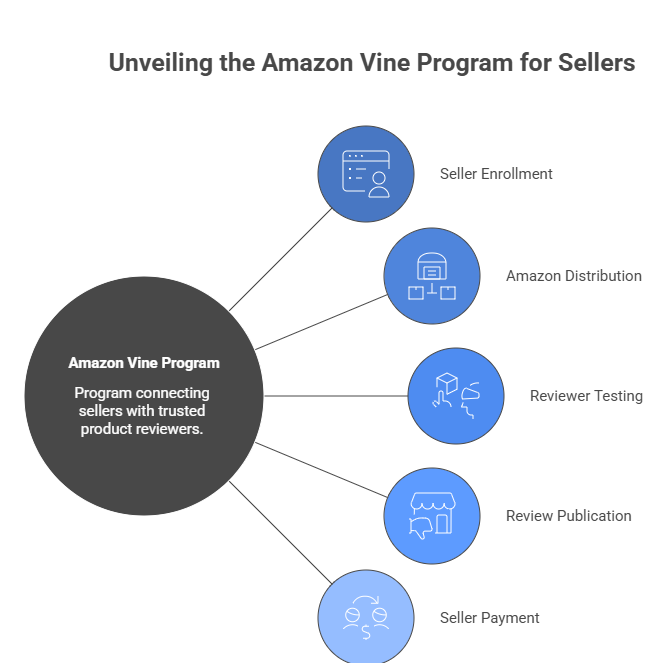
Here’s a simplified breakdown of how the Amazon Vine program for sellers operates from start to finish:
- Seller Enrolls a Product – Through Seller Central, eligible sellers enroll a specific ASIN into the Vine program and provide units to be distributed to reviewers.
- Amazon Distributes to Vine Voices – Amazon’s algorithm matches the product to appropriate Vine Voices based on their review history, expertise, and product category relevance.
- Reviewers Receive and Test the Product – The Vine Voice receives the product free of charge, uses it, and forms their own honest opinion.
- Review Goes Live – The reviewer publishes their Amazon Vine review, positive, neutral, or critical, and it appears on the product detail page with the Vine badge.
- Seller Pays a Fee – Amazon charges sellers an enrollment fee per ASIN, with the cost varying based on the number of reviews requested.
Important: Sellers cannot influence, select, or control what Vine Voices say in their reviews. Amazon strictly prohibits any attempt to manipulate the process. The whole value of Amazon Vine reviews comes from their independence.
How to Join Amazon Vine Program for Sellers (Step-by-Step)
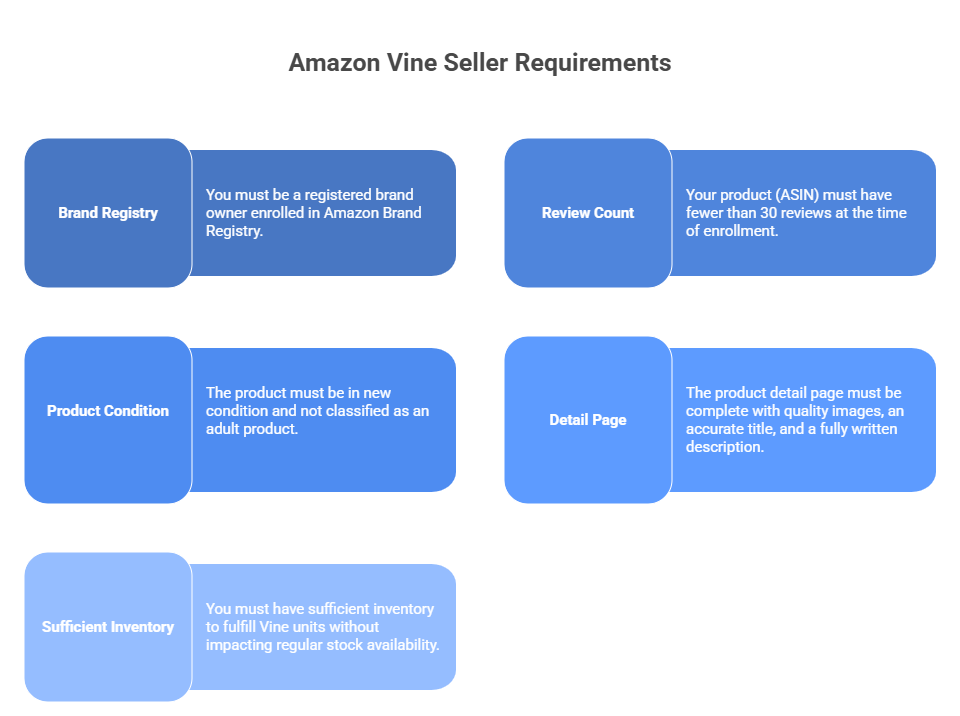
If you’re asking how to join Amazon Vine program as a seller, here’s what you need to know about eligibility and the enrollment process.
Seller Eligibility Requirements
To enroll in the Amazon Vine program, you must meet the following requirements:
- You must be a registered brand owner enrolled in Amazon Brand Registry.
- Your product (ASIN) must have fewer than 30 reviews at the time of enrollment.
- The product must be in new condition and not classified as an adult product.
- The product detail page must be complete with quality images, an accurate title, and a fully written description.
- You must have sufficient inventory to fulfill Vine units without impacting regular stock availability.
Before you begin the enrollment process, it’s important to make sure your product and seller account meet Amazon’s eligibility criteria for the Vine program.
Step-by-Step Enrollment Process
Once your product meets all the eligibility requirements, the next step is enrolling your ASIN into the Amazon Vine program through Seller Central. Here’s how the process works from start to finish:
- Log into Seller Central and navigate to Advertising > Vine.
- Search for the ASIN you want to enroll and confirm eligibility.
- Select the number of Vine units you want to offer, up to 30 units per ASIN.
- Review and accept the program fee. Enrolling for 1 to 2 reviews may be free, while higher tiers carry a flat fee.
- Submit the enrollment and wait for Amazon to handle reviewer matching.
- Monitor incoming reviews through Seller Central. Reviews typically appear within 30 to 90 days.
After enrollment is complete, Amazon takes over the distribution and reviewer matching process. From there, your focus should shift to monitoring feedback, analysing reviewer insights, and optimising your listing based on the reviews you receive.
If you’re looking to improve the visibility of your Amazon product listings beyond reviews alone, this guide on SEO for eCommerce websites explains how strategic optimisation can help increase rankings, organic traffic, and long-term sales performance.
Benefits of the Amazon Vine Program for Sellers
Used correctly, the Amazon Vine program for sellers offers significant advantages, especially for new or relaunched products.
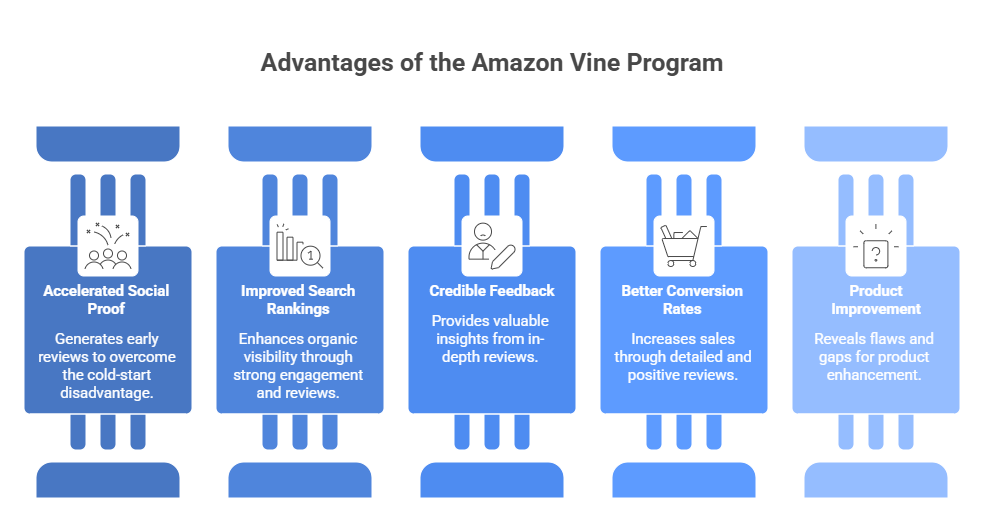
1. Accelerated Social Proof
Vine helps generate early reviews quickly during product launches, helping eliminate the cold-start disadvantage.
2. Improved Search Rankings
Amazon’s A9 algorithm rewards listings with strong engagement and review activity. Early Vine reviews can improve organic visibility faster.
3. Credible and Detailed Feedback
Vine Voices often write in-depth reviews that provide valuable insights for both shoppers and sellers.
4. Better Conversion Rates
Products with multiple detailed reviews generally convert better than listings with little or no social proof.
5. Product Improvement Insights
Critical reviews can reveal product flaws, packaging issues, or listing gaps before scaling advertising efforts.
To stay ahead of evolving eCommerce trends, you can also explore how ChatGPT Instant Checkout AI Shopping is transforming online buying experiences through AI-powered product discovery, conversational commerce, and seamless checkout journeys.
Limitations and Honest Considerations
No tool in your Amazon strategy is perfect, and the Amazon Vine review program is no exception.
1. You Cannot Control Review Outcomes
Vine Voices may leave negative reviews if the product quality is poor. This honesty is part of the program’s credibility.
2. Product and Enrollment Costs
You’re giving away inventory and potentially paying an enrollment fee, so budget accordingly.
3. Not Ideal for High-Ticket Products
For expensive products with high cost-of-goods, giving away units may significantly impact profitability.
4. Marketplace Availability Varies
The Amazon Vine program is available only in select marketplaces, including the US, UK, Canada, Germany, France, and a few others.
Amazon Vine Rules and Best Practices for Sellers
To get the best results while staying compliant:
- Never attempt to contact or influence Vine Voices
- Optimise your listing before enrolling products
- Send your highest-quality inventory for Vine distribution
- Combine Vine with PPC advertising and external traffic campaigns
- Monitor reviews and respond professionally to customer concerns
- Use Vine as part of a broader review and launch strategy
To maximise the benefits of the Amazon Vine program while remaining fully compliant with Amazon’s policies, sellers should follow a few essential best practices.
If you’re building a long-term brand beyond Amazon marketplaces, this guide on D2C eCommerce strategy for online sales success explains how direct-to-consumer brands can increase customer loyalty, improve profit margins, and create sustainable online growth through smarter digital strategies.
Why Authentic Reviews Matter for eCommerce SEO and Conversions
At Radian Marketing, we always emphasise that authentic customer feedback is not just a nice-to-have. It’s a foundational element of sustainable eCommerce growth.
Here’s why reviews matter so much:
- Amazon’s algorithm factors in review velocity, star ratings, and review recency
- Most online shoppers trust reviews as much as personal recommendations
- Reviews create keyword-rich user-generated content that improves listing relevance
- Detailed reviews reduce buyer hesitation and increase purchase confidence
The Amazon Vine program, when used strategically, is one of the most effective ways to build this review foundation while remaining fully compliant with Amazon policies.
You can also read why social media is an important part of inbound marketing to understand how engagement, trust-building, and user-generated content contribute to long-term brand visibility and customer acquisition.
Final Thoughts: Is Amazon Vine Worth It?
For most new or relaunched products, yes, the Amazon Vine program is absolutely worth considering. It’s one of the few Amazon-approved methods for accelerating review generation and building early product credibility.
However, Vine works best when combined with a strong overall launch strategy that includes:
- A fully optimised product listing
- Strategic PPC advertising
- Competitive pricing
- Strong branding and customer experience
At Radian Marketing, we help Amazon sellers create launch strategies designed for sustainable growth through authentic engagement, smart advertising, and data-driven optimisation. If you’re planning your next Amazon product launch, building a review strategy early can make a significant difference in long-term success.