


Shopify vs Square Online Store: Everything You Need To Know
Launching your D2C brand is exciting but choosing the wrong ecommerce platform can quietly limit your customer growth, conversions, and repeat sales. When your goal is to scale faster and build a strong customer base, the Shopify vs Square Online Store decision becomes a critical business move, not just a technical choice.
Each platform offers different strengths in selling, payments, and customer experience, and picking the wrong one can slow your momentum early on. You need a solution that aligns with how you sell today and supports how your brand will grow tomorrow. This comparison is written for you if you are a first-time founder, a bootstrapped D2C startup, or a local brand ready to transition online and attract loyal customers at scale.
What Is Shopify and How Does It Work for D2C Brands?
Shopify is a D2C-first ecommerce platform built to help you launch, manage, and scale your online store from one central dashboard. You can add products, manage inventory, accept global payments, and handle orders without worrying about hosting or technical setup.
For D2C startups, Shopify’s core strengths lie in product management, fast and optimized checkout, built-in hosting, and enterprise-level scalability. As your customer base grows, you can easily add apps for marketing, subscriptions, loyalty programs, and repeat sales without rebuilding your store.
D2C Businesses That Benefit Most from Shopify
Shopify is ideal for you if your D2C brand is built for growth, branding control, and long-term customer relationships.
- Physical product D2C brands – You can manage large product catalogs, variants, inventory, and shipping without technical complexity.
- Subscription-based businesses – You can easily sell recurring products like skincare, supplements, or consumables and drive repeat sales.
- Digital product sellers – You can deliver downloads, memberships, or online content with secure checkout and automation.
- Global-first D2C brands – You can sell internationally with multi-currency payments, localization, and scalable infrastructure.
- Brand-led D2C startups – You get full control over your branding, customer data, marketing tools, and long-term growth strategy.
👉🏻 Book a Free CRO Audit of your D2C Website. Schedule a call now
What Is Square Online Store and How Does Square Online Store Work?
Square Online Store is an ecommerce solution designed for businesses that want to sell online and in person using one connected system. It allows you to create an online store quickly while automatically syncing products, inventory, and orders with Square’s POS.
Square connects your physical point-of-sale and online store seamlessly, so when you sell in-store or online, inventory updates in real time. This is how the Square Online Store works in practice: you add products once, accept payments everywhere, manage customers in one dashboard, and fulfill orders without manual tracking.
Square is best suited for local-first D2C brands, service-based businesses selling products, restaurants, and retailers who want simple setup, lower upfront costs, and unified offline plus online selling.
Choosing the right platform is only step one. To actually bring customers and drive repeat sales, D2C brands also need a strong influencer growth engine. That is where ecommerce influencer marketing becomes a real game changer.
Shopify vs Square Online Store: Core Feature Comparison
Before you choose between platforms, you need a clear, side-by-side view of how Shopify vs Square Online Store perform on features that directly impact customer experience, operations, and repeat sales. This comparison helps you understand which platform supports your D2C growth goals better.
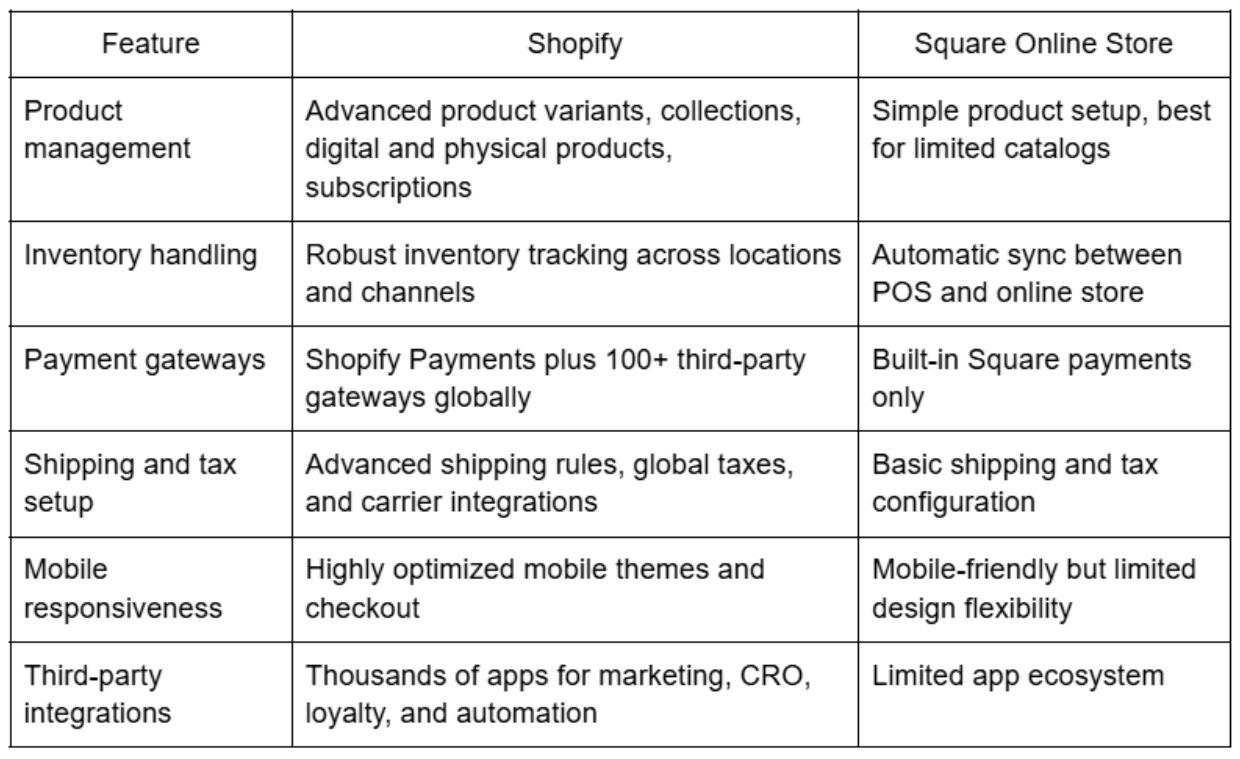
After reviewing this table, the choice becomes clearer: Shopify is built for scalable, brand-led D2C growth with strong support for influencer marketing, advanced integrations, and customer acquisition tools, while Square Online Store focuses on simplicity for local-first, POS-driven businesses with limited marketing and growth flexibility.
👉🏻 Book an Expert zero-commitment Audit of Your D2C Website. Reserve your spot here
Shopify vs Square Online Store: Software and App Ecosystem Comparison
When your goal is long-term D2C growth, the software and app ecosystem behind your store matters as much as design or pricing. Here is how Shopify vs Square Online Store compare across scalability, marketing, analytics, and automation.
App Marketplace Size and Flexibility
Your ability to grow depends on how easily you can extend and optimize your store with powerful tools.
- Shopify offers a massive third-party app marketplace covering SEO, CRO, loyalty, subscriptions, fulfillment, and automation.
- With the Winter ’26 Edition, Shopify has reduced dependency on apps by introducing AI-powered store management via Sidekick AI, which can proactively recommend changes, automate workflows, assist with theme edits, and even help with promotions directly inside your admin.
- Square Online Store has a smaller, tightly integrated ecosystem focused mainly on POS, payments, and basic ecommerce needs.
- For long-term D2C scalability, Shopify gives you far more flexibility to evolve your tech stack as your business grows, both through apps and built-in AI capabilities.
Marketing and Growth Software Support
To bring customers and drive repeat sales, marketing and personalization tools are critical.
- Shopify offers strong SEO tools, on-page optimization apps, and now AI-based domain discovery to help you build search-friendly stores faster.
- Email marketing, automation, upsells, cross-sells, and abandoned cart recovery are more advanced on Shopify, supported by both apps and smarter customer-specific automatic discounts introduced in Winter ’26.
- Square supports basic email campaigns and promotions but offers limited depth for conversion optimization, retargeting, and personalization.
Shopify supports faster D2C scaling through automation, influencer marketing integrations, and performance-focused tools.
Analytics, Reporting, and Data Tools
You need clear insights into customer behavior and sales performance to scale confidently.
- Shopify provides deeper sales analytics, funnel tracking, and conversion reporting.
- Customer behavior tracking and data export flexibility are stronger on Shopify, enabling better decision-making.
Square offers straightforward reporting, best suited for simpler sales models and local businesses.
CRM, Retention, and Advanced Tech Readiness
Retention and automation define sustainable D2C success in 2026.
- Shopify supports CRM tools, loyalty programs, subscriptions, and AI-driven personalization, along with expanded product capabilities like up to 2048 variants per product and unlisted product status for controlled launches.
- Square focuses on basic customer management and repeat purchase tools.
- Shopify integrates better with custom tech stacks, advanced fulfillment automation, and modern D2C workflows.
If you want aggressive growth, advanced marketing, AI-powered optimization, and a future-ready D2C tech stack, Shopify clearly leads. Square works best when simplicity and POS-first selling are your priority.
Your platform choice affects how you sell, but how you attract customers determines whether your store actually grows. Learn the most effective ways to bring buyers to your online store.
👉🏻 Grow your SEO Traffic by up to 3x in 6 months. Talk to an Expert
Square Online Store vs Shopify: Pricing Breakdown (2026 Updated)
If you want a quick cost comparison, here is what you need to know before choosing Shopify vs Square Online Store.
- Square Online Store offers a free plan with no monthly fee, but you pay higher transaction fees on every sale. It is cheaper to start but gets costly as your sales volume grows.
- Shopify has monthly plans starting from a fixed fee, with lower transaction fees as you upgrade. You pay upfront but gain better tools for growth and repeat sales.
- Hidden costs often include apps, email marketing tools, themes, and automation software on Shopify, while Square limits features unless you upgrade.
- Long-term, Shopify is usually more cost-effective for D2C brands focused on scaling, while Square suits small, local-first sellers testing online sales.
Square is cheaper to launch, Shopify is cheaper to scale.
Whether you choose Shopify or Square, you still need traffic that converts. Explore a proven SEO strategy for D2C brands to attract qualified visitors and boost sales.
Shopify vs Square Online Store for D2C Startups: Real-World Use Cases by Industry
Choosing between Shopify vs Square Online Store becomes much easier when you look at how real D2C brands use them across different niches.
Fashion and Lifestyle Brands
You need strong product management, branding control, and global reach to compete in fashion and lifestyle D2C.
Shopify example: A UK-based fashion brand like Hiut Denim Co selling premium denim apparel on Shopify, offering multiple size variants, running influencer-led campaigns, and shipping internationally while maintaining strong brand storytelling and customer loyalty..
Square example: Sidecca is a clothing retailer with multiple categories like dresses, tops, swimwear, and accessories, using Square Online to sell fashion products without complex ecommerce setup.
Food and Beverage D2C
Food and beverage brands rely on repeat purchases, logistics control, and customer subscriptions.
Shopify example: A beverage brand like Athletic Brewing Co., built on Shopify, selling craft non-alcoholic beer direct to consumers online with subscription and nationwide delivery while leveraging Shopify’s ecommerce tools to grow its audience and repeat sales.
Square example: Little Lois Cafe is a local cafe that uses Square Online to sell lunch items and prepared food directly through its online store, making it easy for customers to order ahead for pickup or local delivery.
Local Businesses Going Online
When you move from offline to online, simplicity or scalability becomes the key decision.
Shopify example: A local beauty brand expanding beyond its city to reach national and global customers, like Beauty Bakerie, built on Shopify to sell cosmetics online with strong branding, worldwide shipping, and a loyal community of repeat buyers.
Square example: Seven Grams Caffé uses Square Online to showcase its products and sell food items online, bringing its in-store experience to a broader online audience. Its minimalist, product-focused site design puts customer orders front and center and shows how a local business can transition from walk-ins to online sales with Square’s ecommerce tools.
Shopify fits growth-driven, brand-first D2C startups, while Square excels for local-first and POS-centric businesses.
👉🏻 Need Help with social media strategy? Get Free Consultation Today!
Which Platform Should D2C Startups Choose in 2026?
When choosing between Shopify vs Square Online Store, your decision should align with how fast you want to grow and how complex your D2C operations will become.
When Shopify Is the Better Choice
You should choose Shopify if your goal is long-term D2C growth, brand control, and customer retention.
- You want advanced SEO, marketing automation, and conversion optimization tools.
- You plan to scale globally, run subscriptions, or sell across multiple channels.
You need deep analytics, flexible integrations, and ownership of customer data.
When Square Online Store Makes Sense
Square works well for you if simplicity and local-first selling are your priorities.
- You already use Square POS and want quick online selling.
- You sell limited products or services with in-store pickup.
- You want minimal setup, lower upfront costs, and basic ecommerce features.
Your platform sets the foundation, but your strategy determines success. If you want a roadmap to boost online sales and customer retention, explore this D2C ecommerce strategy guide.
Long-Term Growth vs Short-Term Simplicity
Shopify supports complex D2C growth strategies, while Square focuses on fast, easy launches. Square can feel restrictive as your customer base and marketing needs expand.
Platform Limitations That Affect Scaling
Shopify requires app investments but removes growth limits by supporting quick commerce marketing, influencer campaigns, automation, and advanced integrations. Square limits customization, integrations, quick commerce marketing capabilities, and advanced automation, which can slow scaling over time.
If you are building a serious D2C brand in 2026, Shopify is the future-ready choice. Square is best for testing online sales or supporting local retail.
Final Verdict: Shopify vs Square Online Store
If your goal is to build a scalable, brand-led D2C business that attracts customers and drives repeat sales, Shopify is the stronger long-term choice. It gives you better control over branding, customer data, SEO, marketing automation, and multi-channel growth. Square Online Store works well if you want short-term simplicity, local-first selling, or quick online setup tied to POS, but it can feel limiting as you scale.
👉 Book a free D2C launch consultation with Radian Marketing and get expert guidance on platform selection, SEO, and growth strategy tailored to your business goals.