
How to Use Case Studies in SaaS Content Marketing in Competitive Markets
In competitive SaaS markets, buyers are overwhelmed with similar features, pricing models, and marketing claims. They no longer make decisions based on promises. They look for proof. This shift in buyer behavior is exactly why understanding how to use case studies in SaaS content marketing has become essential for brands that want to stand out and win trust.
Case studies shorten the trust gap in long, high-consideration SaaS buying cycles by showing real customers, real problems, and real outcomes. Instead of asking prospects to believe your messaging, you allow them to see how your product delivered measurable results for businesses like theirs.
Yet most SaaS case studies fail to convert. They are written as static testimonials, disconnected from buyer intent, SEO strategy, and funnel stages. This blog fixes that by showing how to turn customer success stories into high-impact content assets that rank in competitive SERPs, influence buying decisions, and generate qualified SaaS leads.
What Is the Role of Case Studies in SaaS Content Marketing?
In SaaS, not all content is created to convert. Blogs attract and educate. Landing pages persuade. Case studies prove. This is the true role of case studies in SaaS content marketing. They sit at the intersection of trust, validation, and decision-making, especially in competitive B2B SaaS markets.
Difference between blogs, landing pages, and case studies in SaaS
Each content format plays a different role in guiding SaaS buyers from discovery to decision.
- Blogs drive awareness and organic traffic by educating buyers.
- Landing pages focus on conversion through features, benefits, and CTAs.
- Case studies validate outcomes by showing real customer results and usage.
How customer success stories validate product-market fit
Buyers trust solutions that have already worked for companies like their own.
- Show real companies solving real problems using your SaaS.
- Prove your solution works for a specific industry, role, or use case.
- Reduce perceived risk for buyers comparing similar tools.
Why case studies influence pipeline more than traffic
Traffic creates visibility, but proof is what moves deals forward.
- Support mid and bottom-of-funnel decisions.
- Help sales teams overcome objections and shorten sales cycles.
- Strengthen the role of case studies in B2B SaaS marketing by directly impacting deal velocity and revenue.
Case studies may attract fewer clicks, but they consistently drive higher-quality leads and stronger pipeline influence.
If you’ve ever wondered why your SaaS lead volume suddenly dipped, learn how diagnosing a drop in leads can help you refine your content strategy and capture more qualified trials before they reach your competitors.
Why Case Studies Are Critical in B2B SaaS Buying Decisions
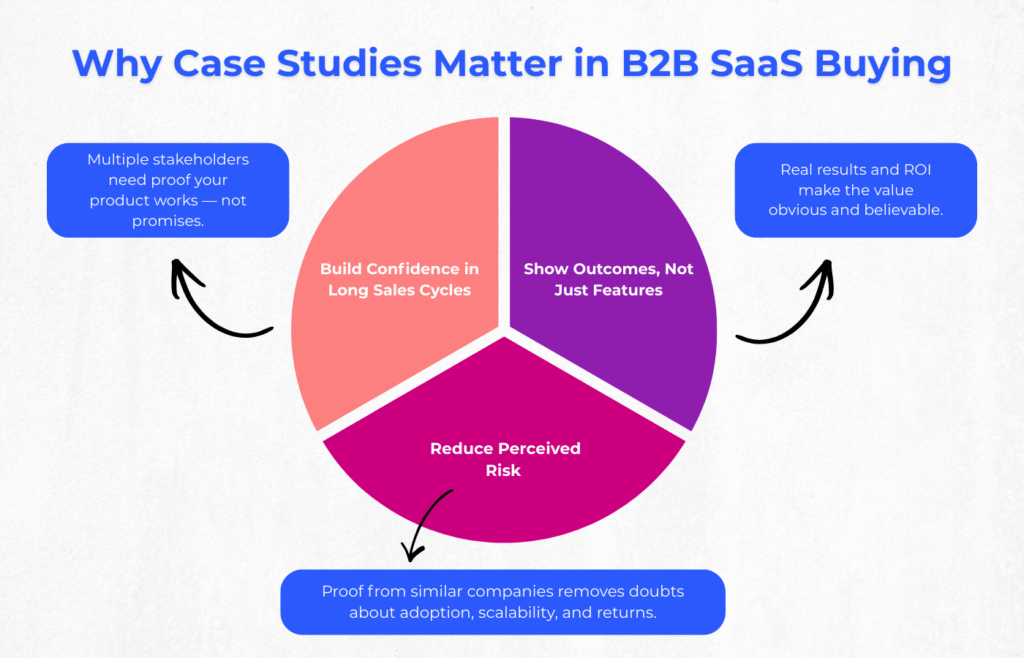
B2B SaaS buying decisions involve long sales cycles, multiple stakeholders, and high perceived risk. At every stage, buyers look for reassurance that the product will deliver real results. This is why knowing how to use customer success stories in SaaS marketing is critical for influencing decisions and accelerating conversions.
Why long SaaS sales cycles need reassurance
In high-consideration SaaS purchases, confidence is built gradually, not instantly.
- Multiple decision-makers need proof before approving budgets.
- Buyers want validation beyond demos and feature explanations.
- Trust must be built consistently across the funnel.
Why decision-makers prefer outcomes over features
What matters most is not what the product can do, but what it has already delivered.
- Features show what the product does, not what it achieves.
- Customer success stories show real implementation and ROI.
- This is how customer success stories are used in SaaS content to build confidence and clarity.
How case studies reduce perceived risk
Risk disappears when buyers see evidence from companies like their own.
- Demonstrate proven results for similar companies or industries.
- Address common objections around adoption, scalability, and ROI.
- Strengthen the role of case studies in B2B SaaS marketing by supporting sales conversations.
- Reinforce the role of case studies in SaaS marketing funnels by guiding buyers through evaluation and decision stages.
Case studies do not just support marketing. They help buyers feel safe choosing your SaaS solution.
For SaaS brands looking to elevate authority and trust, discover how building thought leadership through strategic content marketing complements case study-driven proof and accelerates conversion across the funnel.
Types of SaaS Case Studies That Actually Convert
Not all SaaS case studies influence buying decisions equally. In competitive markets, high-converting case studies are aligned with buyer intent, funnel stage, and specific objections. The table below breaks down the types of SaaS case studies that actually convert and how to use each strategically.
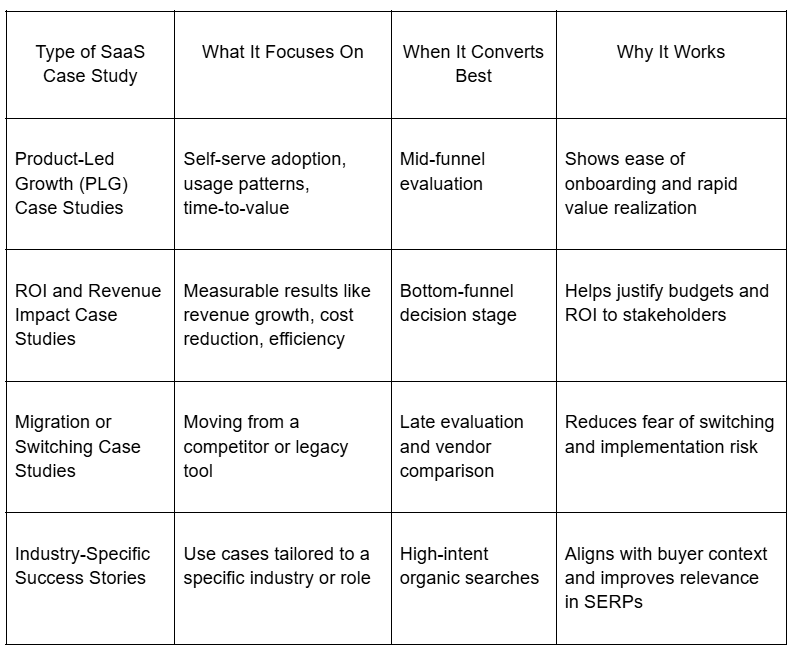
Not every case study serves the same purpose. In competitive SaaS markets, the type of case study you choose determines which buyer concerns you address and how effectively you move prospects closer to a decision.
Tip: Why niche-focused case studies outperform generic ones in competitive SERPs
- Match specific search intent rather than broad keywords.
- Rank better for long-tail, high-conversion SaaS queries.
- Strengthen topical authority for industry-specific SaaS solutions.
- Increase trust by showing relevance, not just results.
In crowded SaaS markets, specificity converts. Generic success stories inform, but niche-focused case studies close deals.
How to Use Customer Success Stories in SaaS Marketing Strategically
Customer success stories become powerful only when they are structured, intentional, and aligned with buyer intent. Knowing how to use customer success stories in SaaS marketing goes beyond collecting testimonials. It requires turning customer experiences into strategic content assets that support growth and revenue.
Turning raw testimonials into structured case studies
- Move from quotes to narratives with a clear problem, solution, and outcome.
- Add context around the customer’s role, industry, and challenges.
- This approach strengthens how to use case studies in SaaS content effectively across channels.
Position the customer as the hero
- Focus the story on the customer’s journey, not your product features.
- Show how the customer made decisions, overcame obstacles, and achieved success.
- This storytelling style reinforces the role of case studies in B2B SaaS marketing by building trust.
Use metrics, timelines, and outcomes
- Include before-and-after data, timelines, and measurable impact.
- Quantified results increase credibility and decision confidence.
- This supports the role of case studies in SaaS marketing funnels, especially at evaluation and decision stages.
When done strategically, customer success stories stop being testimonials and start becoming conversion assets that move deals forward.
To make the most of your case studies, pair them with a well-planned editorial calendar that ensures consistent, strategic SaaS content distribution and keeps your buyers engaged at every stage.
How to Structure a High-Converting SaaS Case Study
A high-converting SaaS case study follows a clear, buyer-focused structure. The goal is not storytelling for its own sake, but proving value at the right moment in the buying journey. This structure shows how to use case studies in SaaS content marketing to support trust, evaluation, and conversion.
Use the problem-solution-results framework
- Start with the business problem the customer faced.
- Explain how your SaaS was implemented as the solution.
- End with tangible outcomes and business impact.
- This framework reinforces the role of case studies in SaaS content marketing as proof-driven assets.
Add measurable KPIs without exposing sensitive data
- Use percentages, ranges, or time-based improvements.
- Focus on outcomes like efficiency, growth, or cost reduction.
- These metrics support the role of case studies in SaaS marketing funnels, especially during evaluation.
Place CTAs that feel helpful, not salesy
- Align CTAs with the reader’s intent, not aggressive selling.
- Offer demos, audits, or relevant resources at the end.
Suggested SaaS case study sections
- Client background: Industry, size, and role context.
- Core challenge: The specific problem limiting growth or efficiency.
- SaaS solution implemented: How your product was used in practice.
- Results and impact: Measurable KPIs and business outcomes.
- Next-step CTA: A logical action aligned with buyer readiness
When structured correctly, case studies guide prospects through decision-making while quietly accelerating conversions.
To ensure your SaaS case studies stay relevant and competitive, stay ahead of evolving content trends that shape buyer expectations and search intent across the funnel.
Role of Case Studies Across the SaaS Marketing Funnel
Case studies are not limited to the bottom of the funnel. When used strategically, they support buyers at every stage of the journey. This is the true role of case studies in SaaS content marketing and why they are so effective in B2B buying environments.
TOFU (Awareness)
- Use educational case snippets to highlight common industry problems.
- Focus on challenges and lessons rather than product features.
- This shows how to use case studies in SaaS content to attract early-stage buyers.
MOFU (Consideration)
- Share comparison-driven and solution-validation case studies.
- Highlight why your approach worked better than alternatives.
- Strengthens the role of case studies in B2B SaaS marketing during evaluation.
BOFU (Decision)
- Use ROI-focused and proof-driven success stories.
- Emphasize measurable outcomes, timelines, and business impact.
- Reinforces the role of case studies in SaaS marketing funnels by supporting final decisions.
How to repurpose one case study across all funnel stages
- Break one full case study into blog posts, landing pages, and sales decks.
- Create short excerpts for TOFU content and detailed versions for BOFU.
- Align messaging to buyer intent without rewriting the core story.
When mapped correctly, a single SaaS case study can influence awareness, evaluation, and conversion without duplication.
How to Distribute SaaS Case Studies for Maximum Visibility
Creating a strong case study is only half the work. Distribution determines whether it drives traffic, trust, and pipeline. A strategic approach ensures case studies support both SEO and revenue goals.
SEO optimization for case study pages
- Optimize for problem-based and industry-specific keywords.
- Add clear headings, schema, and internal links from related blogs.
- This strengthens visibility and supports the role of case studies in SaaS content marketing.
Using case studies in sales decks and email sequences
- Include relevant case studies in sales presentations to address objections.
- Use them in mid and bottom-funnel email nurturing.
- This is how to use case studies in SaaS content to accelerate deal progression.
Repurpose case studies across channels
- Turn full case studies into blogs, LinkedIn posts, and short-form content.
- Use highlights and metrics in paid ads and landing pages.
- Supports the role of case studies in B2B SaaS marketing across touchpoints.
Internal linking strategy to boost authority
- Link from high-traffic blogs to relevant case studies.
- Connect case studies back to feature pages and solution pages.
- Reinforces the role of case studies in SaaS marketing funnels while improving topical authority.
Effective distribution turns case studies into evergreen assets that continuously generate qualified SaaS leads.
Common Mistakes SaaS Brands Make With Case Studies
Even strong customer wins fail to drive results when case studies are created without strategy. To truly understand how to use customer success stories in SaaS marketing, avoid these common pitfalls:
- Writing promotional stories instead of proof-driven narratives, which reduces trust and weakens how to use customer success stories in SaaS marketing
- Focusing on product praise rather than real problems, outcomes, and business impact
- Having no keyword strategy or internal linking, limiting how customer success stories are used in SaaS content for SEO
- Publishing case studies without optimizing them for search intent or discoverability
- Treating case studies as static assets that are never updated with new results or insights
- Failing to align case studies with buyer intent at different funnel stages
- Ignoring the role of case studies in SaaS content marketing as conversion and decision-support assets rather than just testimonials
How Case Studies Help SaaS Brands Win in Competitive Markets
In crowded SaaS categories, features, pricing, and messaging often look identical. What separates winning brands is proof. This is how customer success stories are used in SaaS content to create clarity and confidence when buyers are comparing multiple solutions.
- Differentiation when features look identical – Case studies highlight real use cases, workflows, and outcomes that competitors cannot replicate. This strengthens the role of case studies in B2B SaaS marketing by positioning your product through results, not claims.
- Stronger trust signals for AI-driven search and recommendations – Detailed success stories provide context, entities, and outcomes that AI-powered search engines and recommendation systems prioritize, while also strengthening CRO service performance by improving on-page trust, engagement, and conversion signals.
- Why SaaS brands with case study ecosystems convert faster – Brands that build multiple, industry-focused case studies support every stage of the buyer journey. This ecosystem approach reduces hesitation, accelerates decisions, and increases win rates in competitive markets.
In modern SaaS marketing, case studies are no longer optional. They are the competitive advantage buyers trust most.
Conclusion: Turn Case Studies Into a Revenue Engine for SaaS
In competitive SaaS markets, case studies are not optional. They are one of the strongest trust signals when features, pricing, and positioning look identical. Buyers move forward when they see real outcomes, not promises.
When customer success stories are used strategically across SEO, content, and funnels, they do more than support marketing. They shorten sales cycles, reduce objections, and generate higher-quality leads. This is why leading SaaS brands treat case studies as a system, not standalone assets.
At Radian Marketing, SaaS case studies are built to rank, convert, and influence revenue. This is exactly how to use case studies in SaaS content marketing to turn customer proof into a predictable growth engine.