


D2C Ecommerce Strategy: From First Click to Repeat Customers
For most D2C brands like yours, the challenge is to get traffic, and the bigger challenge is turning that traffic into paying and returning customers. You can have strong ads, social reach, and influencer mentions, yet still struggle with sales. This is the gap between traffic and revenue, and it exists because many brands focus on visibility instead of a conversion driven d2c ecommerce strategy.
A conversion focused D2C marketing strategy prioritizes buyer intent, user experience, trust, and repeat value over vanity metrics like impressions and followers. It aligns every touchpoint from the first click to post purchase engagement with one goal: revenue growth.
In this guide, you will learn how to build a practical digital marketing strategy for online store success, covering customer acquisition, conversion optimization, retention, and repeat purchases using proven online store marketing strategies that actually drive results.
What Is a D2C Ecommerce Strategy in 2026
A D2C ecommerce strategy in 2026 focuses on owning the entire customer journey, from first click to repeat purchase. Instead of chasing traffic alone, modern d2c marketing strategies are built around first party data, personalization, and long term revenue growth through owned channels.
Key points to understand:
- Definition: A modern d2c ecommerce strategy combines SEO, paid media, CRO, email, and retention to drive consistent sales and repeat customers.
- D2C vs marketplaces: Unlike marketplace led selling, D2C gives full control over pricing, branding, and customer experience.
- Customer data advantage: Owning customer data allows smarter segmentation, personalized messaging, and a stronger digital marketing strategy for online store growth.
Stage 1: Building Demand With the Right D2C Marketing Strategy
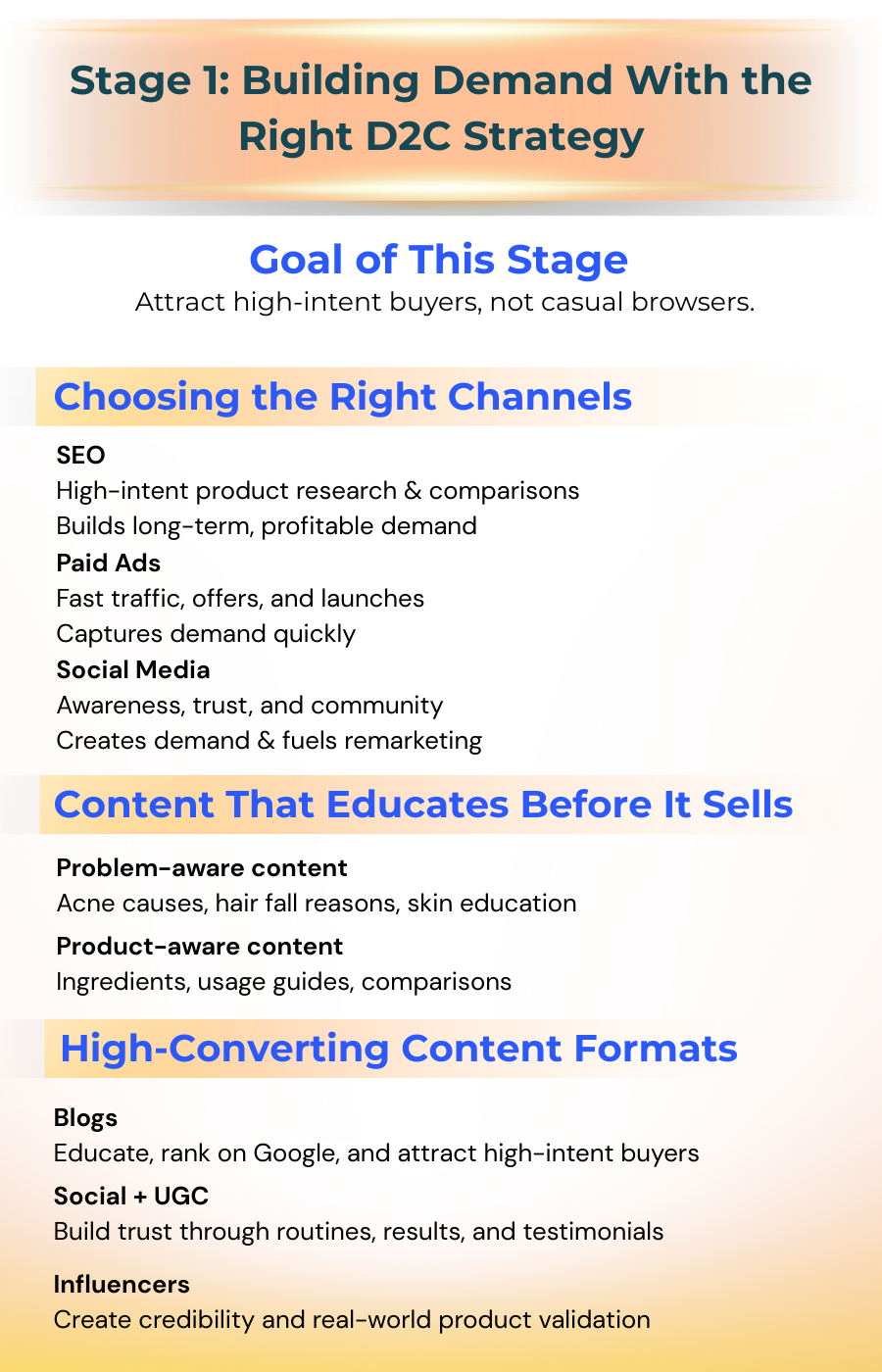
A high performing d2c ecommerce strategy starts with demand generation that attracts buyers who are already close to purchasing, not just casual browsers. The goal at this stage is to show high intent traffic that converts faster and costs less over time.
Choosing Channels That Attract High Intent Buyers
Not all channels serve the same purpose. A smart d2c marketing strategy aligns each channel with a specific level of buying intent.
SEO vs Paid Ads vs Social for D2C Brands
Each channel plays a different role in a high converting d2c ecommerce strategy. The key is not choosing one over the other, but aligning each channel with buyer intent and using them together, including strong SEO services, to drive consistent and profitable growth.
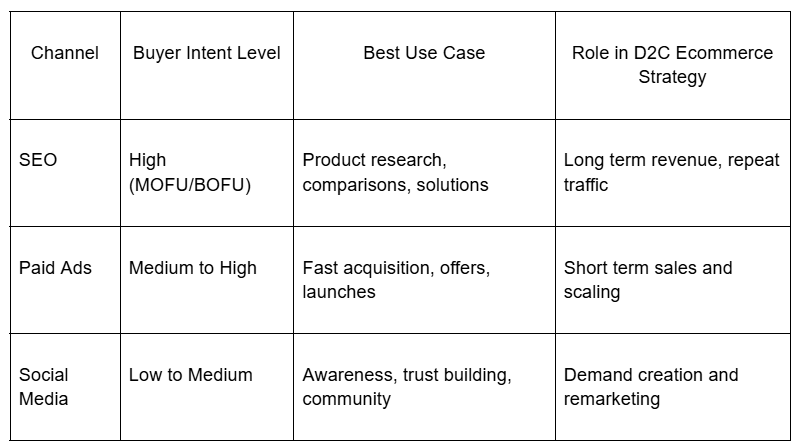
To maximize ROI, your marketing strategy for online store should use social and influencers to create demand, paid ads to capture it quickly, and SEO to sustain it profitably.
Content That Educates Before It Sells
High converting d2c marketing strategies educate users before asking them to buy.
- Problem aware content: Acne causes, hair fall reasons, skin barrier education
- Product aware content: Ingredient benefits, usage guides, comparisons
Content Format Examples for D2C Brands
Each content format plays a distinct role in moving users from awareness to purchase within a high converting d2c ecommerce strategy. When used together, they build trust, intent, and demand.
Blogs:
Blogs are the foundation of a demand driven d2c ecommerce strategy. They educate users before selling, attract high intent organic traffic, and answer real customer questions at different buying stages.
For example, for our client Biovatika, we publish educational blogs around acne care, hair oils, and natural ingredients to attract SEO driven, high intent buyers.
Social + UGC:
User generated reels, before after results, routines, and testimonials reduce hesitation and support conversion focused d2c marketing strategies.
Influencers:
Influencers play a credibility building role in a modern digital marketing strategy for online store growth.
For example, for our clothing client Urban Clad, we collaborated with relevant fashion influencers to showcase real outfit styling and everyday wear, helping build credibility and trust while driving higher engagement and conversions.
This demand first approach ensures your digital marketing strategy for online store brings customers who are informed, confident, and ready to convert.
AI powered shopping experiences are redefining how customers buy online. If you want to see how instant checkout and conversational commerce are shaping the future of D2C, explore how ChatGPT driven checkout is transforming ecommerce buying journeys.
Stage 2: Turning Clicks Into Purchases With CRO
Driving traffic is only half the work. A strong d2c ecommerce strategy focuses heavily on conversion rate optimization (CRO) to turn clicks into actual revenue. Even small CRO improvements can double sales without increasing ad spend.
Optimizing Landing Pages for D2C Conversions
Your landing pages must answer three questions instantly: What is this? Who is it for? Why should I trust it?
Homepage messaging for first time visitors
- Clear value proposition above the fold
- Problem led headline, not just brand slogans
- Primary CTA focused on shopping or exploration
ATF optimization (mainly mobile)
- Product benefit visible without scrolling
- Simple CTA button and minimal distractions
- Fast load speed and clean layout
- Mobile first CRO is critical because most D2C traffic comes from mobile devices.
Checkout Flow Optimization
- Guest checkout option
- Minimal form fields
- Multiple payment methods
- Clear delivery and return information
Reducing friction here directly impacts revenue.
Product Page Elements That Drive Trust
Once users land on a product page, trust becomes the deciding factor between browsing and buying. The following elements directly influence purchase confidence and conversion rates in a strong d2c ecommerce strategy.
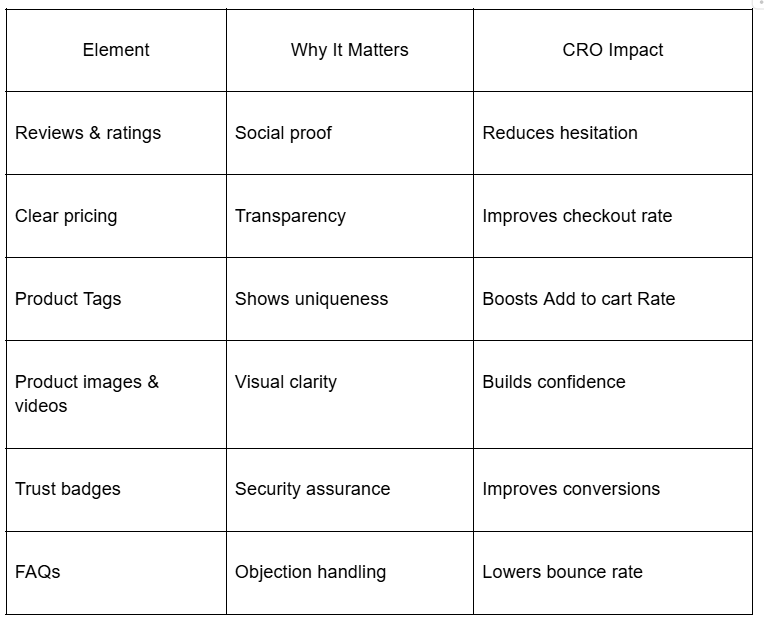
When these elements work together, your product pages support a conversion focused d2c marketing strategy and strengthen your digital marketing strategy for online store growth.
CRO Basics Every D2C Store Must Follow
Once traffic is in place, conversion optimization becomes the foundation of a high performing d2c ecommerce strategy. These CRO fundamentals ensure your d2c marketing strategy turns visitors into customers consistently.
- One primary CTA per page
- Clear benefit driven copy
- Mobile first design approach
- Trust signals on every key page
- Continuous testing and optimization
CRO is what turns a good digital marketing strategy for online store growth into a profitable one.
Trust Signals That Reduce Purchase Anxiety
Trust plays a critical role in any d2c ecommerce strategy, especially at the purchase stage. When buyers feel confident, they convert faster.
Essential trust signals:
- Customer reviews and ratings
- Real testimonials and UGC
- Certifications and quality badges
- Clear return and guarantee policies
Social proof placement tips:
- Near CTAs on product pages
- Below pricing sections
- Inside checkout pages
These elements reduce hesitation and strengthen your d2c marketing strategy for higher conversions.
SEO plays a critical role in attracting high intent buyers to your D2C store. If you want a step by step breakdown of how to build sustainable organic traffic and sales, read our complete guide on how to do SEO for an ecommerce website.
Stage 3: Planning Marketing Strategy for Online Store Growth
At this stage, the focus shifts from short term wins to building a scalable system where acquisition, conversion, and retention work together to drive long term online store growth.
Paid Media Strategy That Supports Profitability
A scalable d2c ecommerce strategy treats paid ads as a demand capture channel. To scale ads without killing margins, D2C brands must focus on blended ROAS, not just platform level performance. This means combining paid traffic with CRO, repeat purchases, and email flows to improve overall profitability.
A funnel based ad structure works best:
- TOFU ads for education and problem awareness
- MOFU ads for product benefits and comparisons
- BOFU ads for offers, reviews, and retargeting
This approach ensures your d2c marketing strategy drives sustainable growth, not short term spikes.
SEO as a Long Term D2C Growth Engine
SEO is the backbone of a profitable digital marketing strategy for online store growth. Informational keywords educate problem aware users, while transactional keywords capture buyers ready to purchase.
Blogs build trust and demand, while optimized product and category pages convert high intent traffic. Together, they reduce dependency on paid ads and improve lifetime value.
Emotional Led Strategy for Social Media
Social media is about connection, not conversion alone. Choose platforms based on where your buyers spend time, like Instagram, YouTube, or TikTok. Share stories, UGC, routines, and brand values to build emotional trust. This strengthens recall and supports long term d2c marketing strategies that convert repeatedly.
Stage 4: Post Purchase Strategy That Drives Repeat Purchases
A profitable d2c ecommerce strategy does not stop at the first sale. Real growth comes from retention and repeat purchases. This is where many d2c marketing strategies outperform marketplaces by owning the customer relationship.
Email and WhatsApp Automation for D2C Retention
Automated flows are essential in a strong digital marketing strategy for online store retention.
- Welcome flows build brand trust and set expectations
- Post purchase flows educate users on product usage and benefits
- Reorder and replenishment flows bring customers back at the right time
Personalization Using First Party Data
Using purchase history, browsing behavior, and preferences allows a smarter marketing strategy for online store personalization. Personalized recommendations and reminders significantly increase repeat conversions.
Loyalty and Subscription Models
Subscriptions work best for consumable products like skincare, nutrition, or wellness. Loyalty programs, rewards, and exclusive access help increase customer lifetime value and make your d2c ecommerce strategy sustainable long term.
Measuring What Actually Matters in a D2C Ecommerce Strategy
A high performing d2c ecommerce strategy focuses on metrics that reflect profitable and scalable growth, not surface level vanity numbers. Tracking the right KPIs helps refine your d2c marketing strategy and ensures your digital marketing strategy for online store efforts drive real revenue.
Metrics That Indicate Scalable Growth
To scale a d2c ecommerce strategy profitably, brands must track metrics that reflect real business health, not just surface level growth.
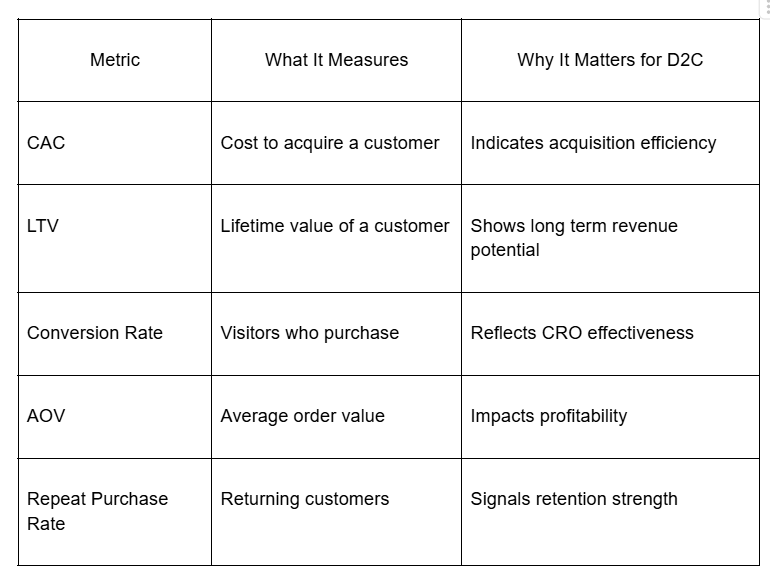
Monitoring these KPIs helps refine your d2c marketing strategy and ensures your digital marketing strategy for online store growth remains scalable and profitable.
CAC vs LTV Alignment
For sustainable d2c marketing strategies, customer lifetime value should be at least 3x higher than acquisition cost. This balance allows brands to scale paid ads, invest in SEO, and grow without margin pressure.
Funnel Stage KPIs for D2C Brands
- Awareness: CTR, engagement rate
- Consideration: time on site, product views
- Conversion: checkout completion rate
- Retention: repeat purchase rate, LTV
These KPIs keep your marketing strategy for online store aligned with profitable growth.
How Radian Marketing Builds High Converting D2C Ecommerce Strategies
Radian Marketing follows a conversion focused d2c ecommerce strategy designed to drive profitable growth, not just traffic.
Strategy first, not channel first
- Business goals and margins defined before execution
- Channels selected based on buyer intent
- Every d2c marketing strategy tied to revenue
Full funnel optimization
- High intent traffic acquisition
- CRO for product and checkout pages
- Retention through email & WhatsApp marketing.
Why D2C brands choose Radian Marketing
- Proven digital marketing strategy for online store growth
- Focus on repeat purchases and LTV
- Scalable, data driven d2c marketing strategies
Proven Results Across High Growth D2C Brands
We have helped D2C brands like Biovatika and Doctor Moringa improve conversions, repeat purchases, and customer lifetime value through a strategy led d2c ecommerce strategy.
Aim for a D2C Strategy Built for Revenue, Not Just Traffic
A successful d2c ecommerce strategy is defined by conversions and retention, not traffic spikes. Brands that win in D2C focus on turning first time visitors into loyal customers through CRO, lifecycle marketing, and repeat purchase systems. This is what makes growth predictable and profitable.
Most D2C brands struggle because their efforts are fragmented. SEO, ads, social, email, and even quick commerce channels often work in silos. A unified d2c marketing strategy connects acquisition, conversion, retention, and quick commerce visibility into one revenue focused system. When all channels support each other, your digital marketing strategy for online store growth becomes scalable and resilient across platforms.
If your brand is getting traffic but not enough sales or repeat customers, it is time to rethink your approach. Consult Radian Marketing to build a conversion driven D2C ecommerce strategy that delivers real business growth.