


Bringing on a dedicated e commerce marketing agency is a huge strategic leap for brands that want to grow beyond their current limits. It’s the move that takes marketing from just another thing on the to-do list and turns it into a powerful engine for growth, filling critical expertise gaps you might have in-house.
Why Hiring an Agency Is a Strategic Growth Move

Let’s be real. In most small and medium-sized businesses, the team is stretched thin, with everyone wearing multiple hats. Maybe the founder is running ad campaigns between meetings, or a customer service rep is trying to keep the social media accounts active. This hustle gets you off the ground, but eventually, you hit a wall. It’s just not scalable.
This is exactly where a specialised e-commerce agency comes in. Think of them less as a vendor and more as a direct extension of your team. They bring a level of focused expertise across multiple marketing disciplines that would be incredibly expensive—if not impossible—to hire for full-time.
From Ticking Boxes to Driving Results
Imagine having a crew of specialists—experts in performance marketing, SEO, and marketplace management—all focused on one thing: your success. Their job isn’t just to complete tasks; it's to drive real, measurable outcomes. They’ve seen what works (and what bombs) across dozens of other brands, and you get to benefit from all that hard-won experience.
Here’s a common scenario: a direct-to-consumer (D2C) brand in India is burning through their ad budget with little to show for it. Their in-house team is spending the money, but the return on ad spend (ROAS) is terrible.
A good agency partner doesn’t just spend your budget; they optimise it. They’ll dive deep into your analytics, refine your audience targeting, and relentlessly test creative until they’ve turned a money-pit into your most profitable growth channel.
This shift from spending to optimising is absolutely critical. The Indian e-retail market is projected to hit an incredible ~$60 billion GMV in 2024, fuelled by over 270 million shoppers. With nearly 60% of new customers coming from Tier-3 cities and beyond, the opportunity is massive. But so is the competition. You need sophisticated marketing to cut through the noise.
Get Access to Expertise You Can't Afford In-House
When you partner with an agency, you’re not just hiring people; you’re gaining access to a full suite of skills, strategies, and technologies. A huge part of this is understanding the benefits agencies gain from their tools, which often include expensive enterprise-level software you wouldn't buy for yourself.
They bring proven workflows and analytical horsepower that turn your marketing spend into predictable revenue. This frees up your core team to focus on what they do best—like developing amazing products and delivering top-notch customer service—while the agency handles the complex work of driving measurable growth. You can dive deeper into this in our complete guide on ecommerce marketing.
Defining What You Actually Need from an Agency

Before you even think about searching for an e-commerce marketing agency, you need a clear blueprint. Going in blind is like grocery shopping without a list—you might come back with something, but it's rarely what you actually needed. The best agency partnerships I've seen always start with a really honest internal audit.
This means translating your big-picture business goals into specific, measurable marketing objectives. "More sales" is not a goal; it's a wish. A real objective sounds more like, "Increase total revenue by 30% in the next fiscal year." See the difference?
From that anchor point, you can work backwards to figure out the marketing key performance indicators (KPIs) that will get you there. To hit that revenue number, for instance, your marketing goal might become, "Achieve a minimum 4:1 Return on Ad Spend (ROAS) on all Meta ad campaigns while scaling the monthly budget from ₹1,00,000 to ₹2,50,000." Now we're talking.
Prioritising Your Core Service Needs
Once your goals are crystal clear, you can start mapping them to specific services. E-commerce marketing agencies offer a massive menu, and trust me, you don't need to order everything at once. Prioritisation is everything.
A new D2C startup, for example, is usually all about generating demand and just getting their name out there. Their immediate checklist would probably look something like this:
- Paid Social Ads: To get targeted traffic in the door quickly and see if the product resonates.
- Influencer Marketing: A great way to build some early social proof and tap into ready-made audiences.
- Basic SEO Foundation: Just making sure the site is technically sound and hitting some obvious, bottom-of-funnel keywords.
On the flip side, an established online retailer with a steady stream of traffic has a completely different set of problems to solve. They're not just trying to get people to the site; they're focused on optimisation and getting more value from each customer.
Their priority list might include:
- Conversion Rate Optimisation (CRO): Squeezing more sales out of the traffic they already have.
- Email & WhatsApp Marketing: Driving repeat purchases and building a loyal customer base.
- Advanced SEO: Going after broader, top-of-funnel keywords to expand their market share.
Knowing where your business is in its journey is critical for picking the right services—and the right agency. If your on-site conversions are poor, looking into a dedicated CRO agency is a much smarter move than just pouring more cash into ads.
Crafting a Clear and Actionable Agency Brief
All this self-assessment work comes together in one crucial document: the agency brief. This is your single most powerful tool in the entire vetting process. It gets every agency on the same page, so you can actually compare their proposals apples-to-apples.
A strong agency brief doesn't just list what you want; it explains why you want it. It provides the context agencies need to develop a truly strategic proposal instead of a generic, cookie-cutter pitch.
Your brief should be a concise but thorough document that covers where you are now, where you want to be, and what's standing in your way. A well-written brief saves everyone hours of back-and-forth and instantly tells potential partners you're a serious, organised client.
Here's what to include in your brief:
- Company Overview: A quick rundown of your brand, your products, and what makes you special.
- Business Goals: The high-level stuff (e.g., increase market share, launch in a new region).
- Specific Marketing Objectives: Your measurable KPIs (e.g., reduce Cost Per Acquisition by 20%).
- Target Audience: Detailed personas of your ideal customers. Who are they?
- Current Marketing Efforts: Be honest. What's working, what's a mess, and what have you tried before?
- Budget: Give a realistic range for both monthly management fees and ad spend.
- Required Services: Your prioritised list of the services you think you need.
Taking the time to define your needs with this level of detail changes the game. You stop vaguely looking for "marketing help" and start strategically seeking a partner built to solve your specific growth challenges. This prep work is the foundation of every successful agency relationship I've ever been a part of.
How to Properly Evaluate Potential Agencies
Alright, you’ve got your shortlist of e-commerce marketing agencies. Now the real work starts. This is where you separate the true partners from the slick pretenders who just talk a good game. The goal isn’t just to hire an agency; it’s to find a team that has a proven history of getting results for businesses just like yours.
First stop: their portfolio and case studies. But don’t just give them a quick glance. You need to dig in. Are the brands they've worked with similar to yours? I'm talking industry, business size, and target customer. An agency that crushes it for a massive fashion retailer might not have a clue how to market a niche D2C food brand. The context matters. A lot.
Beyond the Glossy Case Studies
Let's be honest, case studies are highlight reels. They're designed to make the agency look like a hero. Your job is to read between the lines. Are the results they're boasting about even relevant to your own goals? If you’re desperate for more organic traffic, a case study that only talks about paid ad ROAS shouldn't impress you that much.
Look for a pattern. One monster win is cool, but I'd much rather see a history of steady, repeatable growth across several clients. That tells you their process works and they didn't just get lucky once.
And don't forget to look for testimonials and reviews on third-party sites. An agency’s website will only show you the five-star reviews, but a quick Google search might paint a more realistic picture. A little digging now can save you from a world of pain later on.
Asking Questions That Reveal True Expertise
Those initial calls are your best chance to see how deep their strategic thinking really goes. Anyone can follow a checklist, but you're paying for their brainpower. So, come prepared with questions that cut through the sales pitch.
Don’t just ask about their wins. Ask about their losses. One of my favourite questions is, "Walk me through a campaign that went sideways and tell me how you fixed it." The answer reveals everything about their problem-solving ability, honesty, and how they handle pressure.
Here are a few more to keep in your back pocket:
- Communication Cadence: "What does communication and reporting look like for the first 90 days?" This tells you how organised they are.
- Team Structure: "Who, specifically, from your team will be working on my account? What’s their experience level?" You need to make sure the A-team that sold you doesn't hand your account off to a junior exec.
- Strategic Approach: "Looking at our business, what's our single biggest opportunity for growth, and what's the first thing you'd do to go after it?" This tests if they can think on their feet and apply their knowledge to your business.
Don't just ask what they did; ask how and why they did it. Getting a feel for their process, their reasoning, and their ability to pivot is way more valuable than any vanity metric they throw at you.
This is how you find an agency that builds a real strategy for you, not one that just plugs you into their pre-existing template.
Assessing Performance Marketing Prowess
For most e-commerce brands, performance marketing is the engine room. And in India, that engine is running hot. Digital ad spend is projected to hit a staggering ₹6,79,910 million by 2025. In a market this crowded, you need a partner who can make every rupee count, especially if you're an SMB spending between ₹50,000 to ₹3,00,000 a month on ads. You can discover more insights about performance marketing in India on techeasify.com.
When you're vetting an agency on this front, you need to see hard evidence of a data-first approach. Ask them to show you how they use analytics and testing to squeeze more performance out of a budget.
Here's what a great answer should cover:
- A/B Testing Framework: Do they have a clear, structured system for testing ad creative, copy, and landing pages?
- Audience Segmentation: How do they go about finding and targeting your most valuable customer segments?
- Attribution Modelling: What’s their philosophy on figuring out which channels are actually driving sales?
- Budget Pacing: How do they manage ad spend to make sure you're not burning through your budget by the 10th of the month?
A top-tier agency will talk about these things fluently and give you real examples. If their answers are fluffy or they can't show you a clear process, that's a massive red flag. Go through this process, and you'll walk into every conversation feeling confident, ready to find a partner that can genuinely fuel your growth.
Making Sense of Agency Pricing and Contracts
Agency proposals can feel like you’re trying to read a foreign language. They’re often packed with jargon and complex structures that can be pretty intimidating. But getting a solid grip on how e-commerce marketing agencies price their services and what to look for in a contract is absolutely vital. It protects your business and sets the stage for a partnership that actually works.
Let's pull back the curtain on the most common pricing models you'll come across. Each one has its own rhythm, and the "best" choice really depends on your goals, your budget, and how much risk you're comfortable with.
Comparing E-commerce Agency Pricing Models
The way you pay an agency does more than just affect your bank balance; it shapes the entire relationship. It defines expectations, communication, and, most importantly, results. Nailing this from the get-go isn't just a good idea—it's non-negotiable.
Here’s a quick breakdown of the common pricing structures to help you figure out what makes the most sense for your business.
| Pricing Model | How It Works | Best For | Potential Drawback |
|---|---|---|---|
| Monthly Retainer | You pay a fixed fee each month for an agreed-upon scope of work, like managing ad campaigns or handling SEO. | Businesses needing consistent, ongoing marketing support with a predictable monthly budget. | The scope can be rigid. If your needs change suddenly, you might be paying for services you don't need or lack the flexibility to pivot. |
| Project-Based Fee | A one-time, fixed price for a specific, well-defined project, such as a website redesign or a seasonal campaign launch. | Clearly defined, short-term initiatives with a definite start and end date. | It’s not ideal for long-term, evolving marketing needs. Once the project is done, the engagement ends. |
| Performance-Based | The agency's fee is tied directly to specific KPIs, like a percentage of revenue generated or a fee per lead. | Ambitious brands with clear conversion goals that want to perfectly align the agency's incentives with their own. | Can be complex to track and structure. It also requires a high level of trust and transparent data sharing from day one. |
When you’re looking at these models, it helps to understand the costs behind specific services. For instance, knowing the typical ecommerce photography pricing can give you a better sense of what's a core agency fee versus what's a direct cost for creative work. It just gives you a clearer picture of where your money is going.
Choosing the right model is all about alignment. A retainer offers stability, a project fee provides clarity for one-off tasks, and a performance model ties agency success directly to your bottom line. Think about your immediate needs and long-term goals to decide which path is right for you.
Don't Skip the Fine Print in Your Contract
Once you've agreed on a price, the contract—or Service Level Agreement (SLA)—comes next. Think of this document as the official rulebook for your partnership. Don't just give it a quick scan. You need to read every single line.
A contract isn't just a formality; it's a tool for alignment. A good contract protects both you and the agency by making sure everyone is crystal clear on the objectives, responsibilities, and rules of engagement.
Here are the clauses that you absolutely cannot afford to ignore:
- Scope of Work (SoW): This needs to be incredibly specific. "Manage social media" is way too vague. A solid SoW will detail exactly which platforms, the number of posts per week, community management duties, and how often you'll get reports.
- Deliverables: What are you actually getting for your money? This section should list tangible outputs, like monthly performance reports, keyword ranking dashboards, or a specific number of ad creatives.
- Termination Clause: Things don't always work out. What happens if you need to part ways? Look for a reasonable notice period, usually 30 days, that lets you exit the agreement without a massive penalty. Be very cautious of agencies that try to lock you into long, inflexible contracts.
- Data and Asset Ownership: This one is critical. The contract must clearly state that you own all your data, ad accounts, and any creative assets produced for you once they're paid for. You should never be in a position where an agency can hold your accounts hostage.
Spotting the Red Flags Before You Sign
The proposal and contract stage is where an agency really shows its true colours. A few things should make you hit the pause button and think twice. An agency that's confident in its work won't need to hide behind confusing language or fuzzy promises.
Keep an eye out for these warning signs:
- Guaranteed Results: This is the biggest red flag of them all. No legitimate e-commerce marketing agency can guarantee a #1 Google ranking or a specific ROAS. There are just too many variables. They should promise a proven process and hard work, not an impossible outcome.
- Vague or Unclear Scope: If the "deliverables" are full of fluffy terms like "strategic oversight" or "brand enhancement" without concrete actions tied to them, run. You're probably signing up for a whole lot of nothing.
- Lack of Reporting Details: The proposal should spell out exactly what metrics they’ll track and how often they'll report on them. If they can’t tell you how they’ll measure success, they likely don’t have a solid plan to achieve it.
The e-commerce world in India is exploding, with ad revenues on major platforms projected to soar past Rs. 15,000 crore (US$ 1.7 billion) in FY25. This massive growth just goes to show how critical data-driven strategies are, and your contract needs to reflect a partnership that’s laser-focused on measurable performance. Taking the time now to properly vet the commercial and legal details will set you up for a partnership built on trust and clarity from day one.
Building a Successful Agency Partnership from Day One
Signing the contract isn't the finish line; it's the starting gun. A truly great partnership with an e-commerce marketing agency is built on collaboration and crystal-clear communication, especially during those critical first 90 days. This period really does set the tone for everything that follows.
The partnership officially kicks off with a kick-off meeting. This isn't just a formality—it's your most important session. Here, both teams move beyond the proposal and get real about the day-to-day of working together. You'll figure out a communication rhythm, set up shared dashboards, and grant all the necessary access to your analytics and ad accounts.
Establishing Your Onboarding Roadmap
A structured onboarding process is your best defence against misunderstandings and ensures you hit the ground running. The whole point is to get your new agency partner up to speed on your brand, customers, and internal processes as quickly as humanly possible. This phase is less about launching massive campaigns and more about building a rock-solid foundation.
Your agency should take the lead here, but your active participation is non-negotiable. Be ready to share everything from brand guidelines and past campaign data to detailed customer personas. The more context you can give them, the faster they can start delivering work that actually moves the needle.
Here’s a practical look at how an engagement might evolve, shifting pricing models as trust is built and goals get more ambitious.
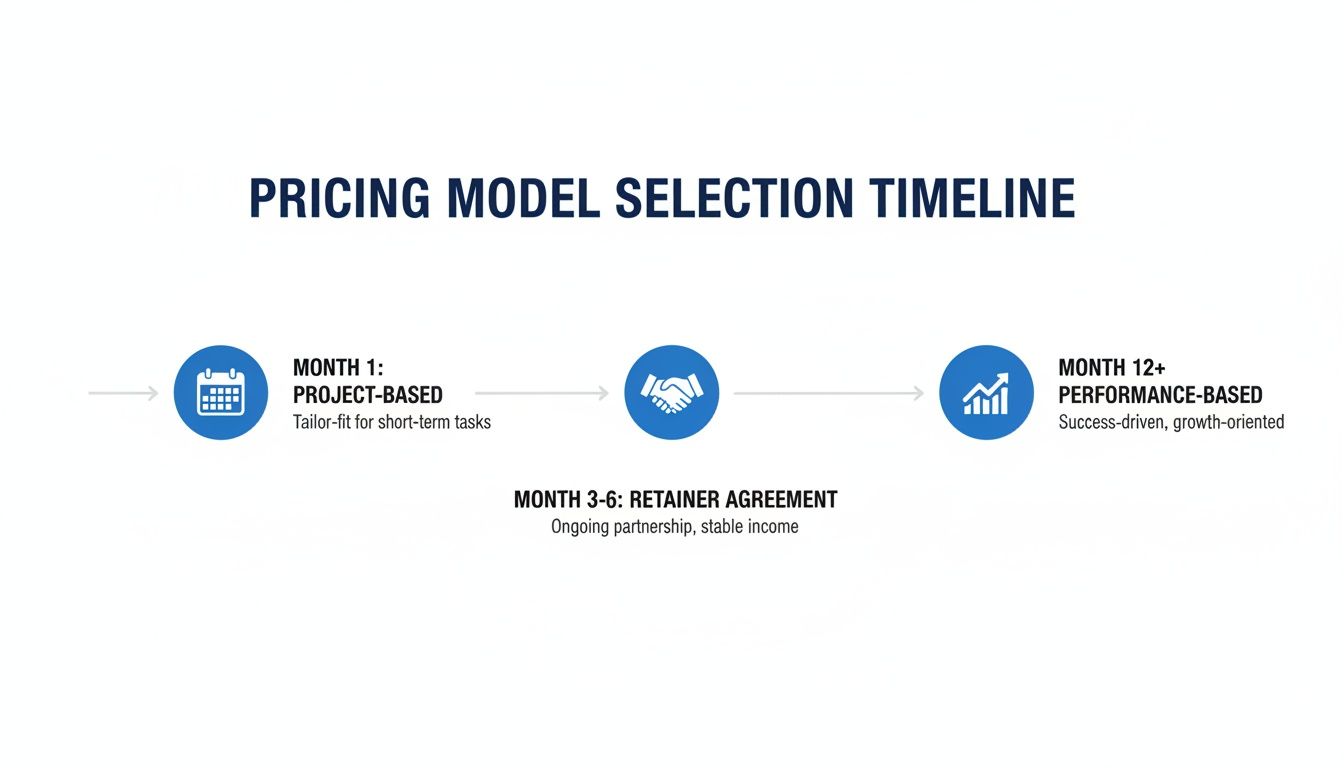
This visual shows a common path: a partnership might start with a defined project, move to a steady retainer for ongoing work, and eventually shift to a performance model once a solid baseline is established.
Defining and Tracking the Right KPIs
Let's be honest: you can't improve what you don't measure. A huge part of onboarding is finalising the Key Performance Indicators (KPIs) that will define what "success" actually looks like. These metrics absolutely must tie directly back to the business objectives you laid out in your initial brief. Vague goals just lead to vague, disappointing outcomes.
A great agency will come to the first meeting with a proposed KPI dashboard template, already customised for your specific needs. This dashboard becomes your shared source of truth, giving everyone a transparent, no-fluff view of performance.
Here’s a sample breakdown of what that might include:
For SEO:
- Organic Traffic: The total number of visitors finding you through search engines.
- Keyword Rankings: Tracking your position for your most important commercial keywords.
- Conversion Rate from Organic: The percentage of organic visitors who actually buy something.
For PPC (e.g., Google & Meta Ads):
- Return on Ad Spend (ROAS): The core profitability metric. How much revenue are you generating for every rupee spent on ads?
- Cost Per Acquisition (CPA): How much does it really cost to get a new customer through the door?
- Click-Through Rate (CTR): A great pulse check for ad relevance and creative effectiveness.
For Social Media Marketing:
- Website Conversions: How many sales can be directly traced back to your social media channels?
- Engagement Rate: How actively is your audience interacting with your content? Likes are nice, but comments and shares are better.
This dashboard isn't a "set it and forget it" tool. It should be the centrepiece of your weekly or bi-weekly check-in calls, allowing both teams to analyse what's working, what's not, and where to pivot next.
The most productive agency relationships feel like a true partnership, not a client-vendor transaction. This means treating your agency team as an extension of your own, fostering open communication, and actually being receptive to their strategic recommendations.
Ultimately, building a successful partnership takes real effort from both sides. Provide clear, constructive feedback—celebrate the wins and be direct about your concerns. When you empower your agency with trust and the information they need, you create an environment where they can do their best work. This collaborative approach is what turns a good agency engagement into a powerful engine for long-term, sustainable growth for your e-commerce business.
Finding the Right Growth Partner for Your Brand
Choosing an e-commerce marketing agency is one of the biggest growth decisions you'll make. I'm not just talking about outsourcing a few tasks; this is a serious investment in a partner who needs to get your vision, especially in a market as bustling as India's. This whole process needs a thoughtful approach, not a rushed one.
It all starts with getting crystal clear on what you actually need. You have to turn those big-picture business goals into sharp, specific marketing objectives. Once you have that clarity, you can start vetting agencies with real intention, looking past the slick presentations to find a team with genuine, relevant experience. Don't be afraid to dig into their case studies, ask tough questions, and find a team whose strategic thinking genuinely clicks with your brand’s ambition.
Securing a True Partnership
Next up, the commercials. Getting a solid handle on everything from pricing models to the fine print in the contract is completely non-negotiable. This isn't just about protecting your business; it's about setting clear expectations from the get-go to avoid headaches down the line. And remember, signing the contract is just the starting line. The real work is in building a strong, collaborative partnership from day one, built on open communication and shared accountability for the results.
You’re not just hiring a service provider; you're bringing a dedicated growth partner into the fold. The right agency acts like an extension of your own team, bringing specialised expertise to the table that can seriously speed up your progress.
Armed with the frameworks in this guide, you should feel much more confident starting your search. This prep work puts you in a great position to find the right ally to help you grow. As you get deeper into your strategy, you might find our detailed breakdown of digital marketing for ecommerce and D2C companies really useful.
With the right partner on your side, your business will be in a much better spot to tackle challenges and grab the massive opportunities waiting in India's competitive e-commerce space. You've got the tools now—go make a strategic choice that drives real, lasting success.
Frequently Asked Questions
Hiring an e-commerce marketing agency is a big decision, and it’s completely normal to have questions. This is where we tackle some of the most common, practical concerns that pop up when business owners start thinking about a partnership. Getting these answers upfront helps set the right expectations from day one.
Finding the right partner can completely change your growth story. But it all starts with asking the right questions and understanding what's typical in terms of services, costs, and results.
How Much Should I Expect to Pay for an Agency in India?
This is the big one, and the honest answer is: it varies a lot. The cost really depends on what you need and the agency's track record.
If you’re a small business just getting your feet wet, you might look at a monthly retainer between ₹30,000 and ₹50,000. This usually covers a single, focused service like SEO or some basic social media management.
For growing SMBs that need a full-blown, multi-channel strategy, retainers typically climb to the ₹1,00,000 to ₹3,00,000+ per month range. Keep in mind, this fee is for the agency's time, expertise, and management. You absolutely have to clarify if this includes your ad budget. Almost always, your ad spend is a separate cost billed directly to you by platforms like Google or Meta.
When Is It Right to Hire an Agency Instead of an In-House Team?
The perfect time to bring in an agency is when you need deep, specialised expertise across multiple marketing channels that would be a nightmare (and incredibly expensive) to hire for internally. Think about it: finding one person who’s a pro at SEO, Google Ads, Meta Ads, and email marketing is nearly impossible.
If your current team is stretched to its limits and you need to ramp up your marketing now, an agency is your best bet.
A hybrid model often works wonders. Many successful businesses keep a marketing manager in-house to own the strategy and act as the main point of contact. They then partner with an external agency that handles the nitty-gritty execution and channel-specific work. It’s the best of both worlds.
On the flip side, if you have a very clear, long-term need for a single role—say, a full-time content writer—hiring an in-house employee probably makes more financial sense.
What Results Can I Realistically Expect in the First Three Months?
Your initial wins will depend entirely on which marketing channels you're using. It's so important to have a realistic timeline for different strategies.
- Paid Advertising (PPC & Social Media): You should see traffic and some initial sales data rolling in within the first month. The first 90 days are all about optimisation—tweaking campaigns to improve crucial metrics like your Return on Ad Spend (ROAS).
- Search Engine Optimisation (SEO): This is a marathon, not a sprint. In the first three months, expect the agency to be laying the groundwork: technical audits, keyword research, content planning, and maybe some small upticks in keyword rankings. You won't see significant jumps in organic traffic until at least the six-month mark.
Any agency worth its salt will give you a clear timeline with expected milestones right from the start. If they promise you the moon overnight, run.
Ready to find a growth partner that actually delivers? At Radian Marketing, we don’t just work for you; we work with you, becoming an extension of your team. We build data-driven strategies that turn your marketing spend into predictable, scalable revenue.
Discover how our e-commerce expertise can help you scale.
Built with Outrank