


Ever wondered what goes on in a customer's mind when they're browsing your website? That's the core of online consumer behaviour. It's all about understanding the entire digital journey—from the moment someone types a query into Google to the final click on the "buy" button.
We're diving into the motivations, habits, and the little psychological nudges that influence every online purchase.
Why Online Consumer Behaviour Is Your New Competitive Edge

Think of your website as a lively marketplace. Every click, every scroll, every search is a quiet conversation with a potential customer. Getting a grip on online consumer behaviour is simply the art of listening in on these digital chats, turning a stream of anonymous data into real business intelligence.
This isn't just theory; it’s a modern-day necessity for any business wanting to grow. When you can decode these digital footprints, you start attracting the right people, building loyalty that lasts, and making much smarter decisions with your marketing budget. It's the difference between guessing what your customers want and knowing what they need.
The Shift from Observation to Understanding
In a physical shop, a manager can easily spot a confused customer. They see which products people pick up, where they pause, and what makes them frown. Online, those visual cues are replaced by a trail of data—clicks, how long they stay on a page, and what's left in abandoned carts.
Analysing online consumer behaviour lets you translate this raw data into powerful insights. For example, a high bounce rate on a product page isn't just a number. It's a signal telling you something is off—maybe your pricing, your images, or your product description isn't hitting the mark. This deeper understanding is what helps great brands stand out from the digital noise.
"A key discovery from recent research is that most shoppers prefer multiple touchpoints from brands before they convert to a purchase. In fact, 56% of consumers now spend more time researching products before making a final decision."
This stat drives home a critical point: the modern buyer's journey is rarely a straight line. It’s a messy, winding path that weaves through search engines, social media feeds, and review websites.
The Four Pillars of Online Consumer Behaviour
To really get to grips with how your customers think and act online, it helps to break it down into four fundamental areas. These pillars form the foundation of any solid digital strategy.
| Pillar | Description | Key Business Question |
|---|---|---|
| Psychological | These are the internal drivers like motivations, perceptions, and attitudes that shape buying decisions. It's the "why" behind their actions. | What emotional needs or problems does our product solve for the customer? |
| Personal | This covers individual characteristics like age, lifestyle, income, and personality. A student's buying habits differ vastly from a CEO's. | Who is our ideal customer, and what does their daily life look like? |
| Social | Humans are social creatures. This pillar includes influences from family, friends, social status, and online communities (like reviews or influencer posts). | Where do our customers get recommendations, and who do they trust? |
| Technological | This relates to the user's interaction with technology itself—their device (mobile vs. desktop), site speed, and the ease of navigating your website. | Is our website easy and intuitive to use on any device? |
By looking at your customers through these four lenses, you can start building a complete picture of who they are and what they need from you.
Benefits of Mastering Consumer Insights
When you truly focus on understanding your online customers, you stop reacting and start anticipating. You can guide them through their journey because you know what they're looking for.
Here are the key advantages you'll unlock:
- Improved Personalisation: Deliver product suggestions and content that actually feel relevant to each user. They'll feel like you "get" them.
- Enhanced Customer Experience: Find and fix the annoying friction points on your site. A smoother checkout process means fewer abandoned carts.
- Higher Conversion Rates: When your website's design, offers, and messaging align with what users expect, more visitors will turn into customers.
- Increased Customer Loyalty: A great experience brings people back. You’ll turn one-time buyers into genuine fans who advocate for your brand.
Ultimately, mastering these insights gives your business a real, sustainable edge in a very crowded online world.
Exploring the New Wave of Indian Digital Consumers
India’s digital marketplace is in the middle of a massive shake-up. For years, online commerce was a game played mostly in the big metro cities. But that’s all changing. The real engine of growth isn't just humming in Mumbai or Delhi anymore; it's roaring to life in the heartlands.
What's behind this incredible shift? It’s a perfect storm of affordable data plans, smartphones in nearly every hand, and more disposable income outside the major urban centres. This has thrown the doors open for millions of new shoppers, people who are coming online for the first time with their own unique habits and expectations. For any business that wants to make it in India, understanding this new wave isn't just an option—it's essential.
The Rise of Tier-2 and Tier-3 Cities
The single biggest change in Indian online consumer behaviour is the explosive growth coming from smaller cities and towns. These places used to be considered secondary markets, but now they're the primary drivers of e-retail growth. This has created a huge, untapped opportunity for brands smart enough to look beyond the usual suspects.
The numbers don't lie. India's e-retail market has ballooned to an estimated $60 billion in gross merchandise value (GMV), making it the world's second-largest base of online shoppers with over 270 million people participating. Since 2020, an incredible three out of five new shoppers—that’s almost 60%—have come from Tier-3 cities and even smaller towns. This has unlocked brand-starved regions that were once out of reach. In fact, areas like the Northeast now show an e-retail penetration that is 1.2 times higher than the national average.
Just look at the growth trajectory of ecommerce in India over the last decade.
This chart makes it crystal clear—the market has grown exponentially, showing just how deeply online shopping has woven itself into the fabric of the country.
Understanding Diverse Generational Habits
But this new, expanded audience isn’t one big, uniform group. Different generations interact with the online world in completely different ways. Slapping a one-size-fits-all strategy on them is a recipe for failure. To really connect, you have to get a handle on what makes each group tick.
Gen Z (Born 1997-2012): These are the true digital natives who live and breathe social media. Their buying decisions are almost entirely shaped by social proof, what influencers are recommending, and user-generated content. They crave authenticity and jump on new trends in a heartbeat, which makes platforms like Instagram and YouTube your go-to channels to reach them. They expect a flawless mobile experience and are drawn to brands that stand for something.
Millennials (Born 1981-1996): As the original digital pioneers, millennials are smart, research-driven shoppers. They will meticulously compare prices, comb through reviews, and hunt for the best value. While social trends definitely influence them, they also put a lot of weight on brand reputation and detailed product info. They move seamlessly between their phones, laptops, and tablets and expect your brand to keep up with a consistent experience everywhere.
Older Generations (Gen X and Baby Boomers): They might have been a bit slower to the ecommerce party, but older consumers are now a fast-growing online segment. Their confidence in digital payments and online shopping is climbing steadily. For this group, it’s all about trust, reliability, and clear communication. They appreciate websites that are easy to navigate, top-notch customer service, and brands that have built a solid reputation for quality over the years.
By 2030, India is projected to have over a billion internet users, and the vast majority will be accessing it on their phones. This mobile-first reality means every single touchpoint, from the first ad they see to the final checkout click, has to be perfectly optimised for a small screen.
This mobile-dominated behaviour highlights just how crucial it is to get local and cultural. Your marketing can't just be tailored to a city; it has to speak to the specific cultural nuances, languages, and preferences of a region. For any business trying to capture this expanding audience, figuring out how to attract customers to your online store with targeted, thoughtful approaches has never been more important. It all starts with building trust, and that begins by showing this new audience you actually understand their world.
Navigating the Modern Indian Customer Journey
Forget the old sales funnel. That simple, straight line from awareness to purchase is a thing of the past. Today's path looks more like a tangled web, with customers bouncing between Google searches, social media feeds, review sites, and your website before even thinking about buying. Getting a handle on this messy, multi-touchpoint reality is the key to mapping the modern Indian customer journey.
To guide customers effectively, you have to meet them where they are. This means you need to boost your ecommerce customer experience by tailoring your strategy to their specific stage in the journey. That could mean using smart SEO to show up during their initial search, running targeted PPC ads while they compare options, or designing a buttery-smooth checkout process to seal the deal.
This isn't just happening in the big cities, either. The digital wave is spreading across India, bringing new customers from smaller towns and cities online every day.
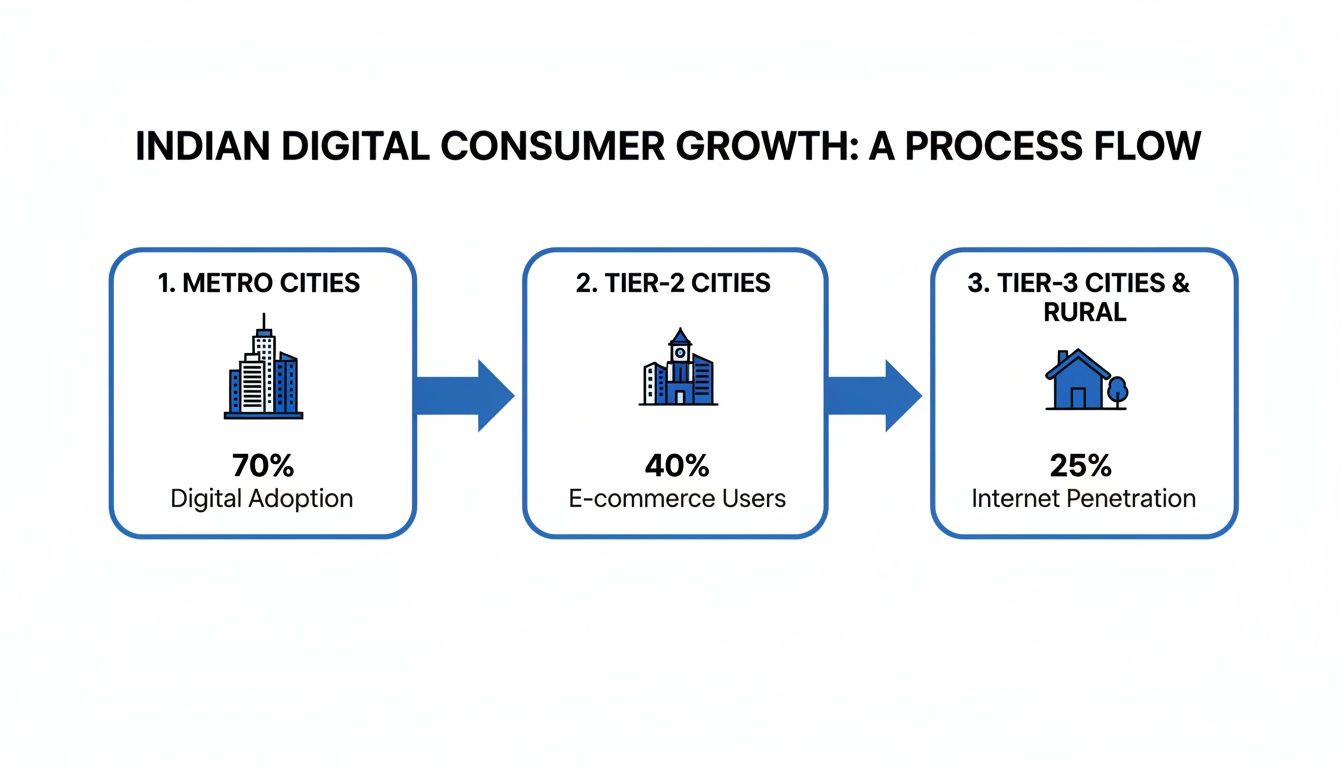
As you can see, this growth in Tier-2 and Tier-3 cities is creating entirely new markets. These customers have their own unique needs and online behaviours that you need to understand.
Stage 1: The Discovery Phase
This is the "lightbulb" moment. Your future customer has just realised they have a problem to solve or a desire to fulfil, but they aren't sure what the solution is yet. Their behaviour is purely exploratory. They’re typing broad searches into Google, like "best running shoes for men" or "how to fix a leaky tap."
Your goal here is simple: be visible. You have to pop up the moment they start looking.
- SEO is Your Best Friend: Focus on creating helpful blog posts, guides, and articles that answer their early-stage questions. Optimising for these longer, more specific search queries can bring in highly qualified traffic.
- Get Social: Use platforms like Instagram and Facebook to show your products in real-life situations. This helps people discover your brand even when they aren't actively shopping.
Stage 2: The Consideration Phase
Okay, so they know they have a problem and they're aware of some potential solutions. Welcome to the consideration phase. Now, the real research begins. They're actively comparing different brands and products, and their searches get much more specific. Think "Brand X phone vs. Brand Y phone" or "reviews for XYZ laptop."
This is where you need to build trust and give them all the details they're looking for.
Recent studies show that 56% of consumers now spend more time researching products online before they buy. They're hunting for reviews, testimonials, and detailed specs to feel confident in their choice.
It's your chance to stand out. Build out your product pages with in-depth information, offer downloadable spec sheets, and create video demonstrations. Most importantly, encourage and prominently display customer reviews. Nothing builds confidence like seeing that other people have already bought—and loved—your product.
Stage 3: The Conversion Phase
This is it, the moment of truth. They've done their homework and are ready to pull out their wallet. Your one job is to make this step as easy and frictionless as humanly possible. Any small hiccup—a slow-loading page, a confusing form, or a surprise shipping fee—can send them running for the hills.
Conversion Rate Optimisation (CRO) is the name of the game here.
- Simplify Your Checkout: Offer a guest checkout option and keep the number of required fields to a bare minimum.
- Offer Plenty of Payment Options: Make sure you include popular methods like UPI, credit/debit cards, and major digital wallets.
- Be Transparent About Costs: Show all costs, including taxes and shipping, right from the start. Nobody likes a nasty surprise at the final step.
Stage 4: The Loyalty and Advocacy Phase
The journey isn't over once the payment goes through. Far from it. The post-purchase experience is where you transform a one-time buyer into a raving fan who comes back again and again. This final stage is all about customer satisfaction, repeat business, and powerful word-of-mouth marketing. To get a clear picture of these ideal customers, take a look at our guide on how to create customer personas.
Building loyalty is about staying engaged and providing top-notch service. Send follow-up emails with tracking information, ask for their feedback on the product, and maybe even offer a small discount on their next purchase. A great experience will encourage them to leave a positive review and tell their friends about you, which sends a fresh wave of new customers right back to the discovery phase.
The Hidden Psychology Behind Clicks and Conversions
What really makes a customer click ‘Add to Cart’? It’s rarely just about the features or the price tag. Underneath the surface, powerful and unspoken psychological principles are always at play, shaping how people behave online and influencing every single decision they make on your website.
Think of these principles as the invisible strings that connect a person's subconscious needs to your marketing. If you learn to see these strings, you can build real trust, create a genuine connection, and ethically guide users toward making a purchase. These aren't sneaky tricks; they're proven ways to show your value more effectively.
The Power of Following the Crowd
One of the most powerful drivers is social proof. It’s the simple idea that we assume the actions of others are the correct ones. If a restaurant is packed, we figure the food must be good. This same principle is a massive deal online.
Online reviews, customer testimonials, and user-generated content are the digital version of that busy restaurant. They offer validation from peers, which people often trust far more than a brand's own marketing spiel. In India, this is especially true. Recent data shows a massive 54% of shoppers always check reviews before buying anything, which tells you just how much trust and careful thought goes into their online shopping.
How can you put this to work?
- Showcase Customer Reviews: Make them front and centre on your product pages.
- Use Testimonial Blocks: Feature quotes from happy customers right on your homepage.
- Highlight "Bestseller" Badges: Clearly signal which products are the popular choices.
Creating Urgency with Scarcity
Ever felt that sudden urge to buy something because it was the "last one in stock" or part of a "limited-time offer"? That's scarcity at work. This principle hinges on the fact that people value things more when they believe they're in short supply.
This taps directly into our fear of missing out (FOMO). When an opportunity feels like it’s about to disappear, we're much more motivated to act on it right away. Ecommerce brands are masters at this, using it to speed up the decision-making process and push for immediate action.
By framing an offer as scarce, you shift the customer's mindset from "Should I buy this?" to "Should I buy this now before it's gone?" This simple change can dramatically reduce hesitation and cart abandonment.
A great example is a travel website showing "Only 2 rooms left at this price!" or a fashion retailer running a "24-hour flash sale." Both use scarcity to create a sense of urgency that gets people to convert.
Building Trust Through Authority
Why do we take a doctor's medical advice or listen to a financial expert's investment tips? It all comes down to authority. We are hardwired to follow the lead of credible, knowledgeable experts. In the digital world, your brand needs to become that authority in its field.
This doesn't happen overnight. You build it by consistently delivering value and proving you know your stuff.
- Influencer Marketing: When you team up with respected figures in your industry, their credibility rubs off on your brand. Their endorsement is a powerful trust signal for their followers.
- Certifications and Awards: Displaying industry awards, security badges (like SSL certificates), or official accreditations gives your site an instant credibility boost.
- Expert Content: Publishing in-depth blog posts, white papers, or case studies shows you're a go-to resource, building your reputation over time.
Getting a handle on what truly motivates your customers is everything. For those who want to dig deeper, exploring the psychology of influence can offer powerful insights into why these principles are so effective. By ethically weaving these psychological triggers into your site, you can create a more persuasive and trustworthy experience that turns casual browsers into loyal buyers.
How to Measure and Analyse Consumer Behavior Data
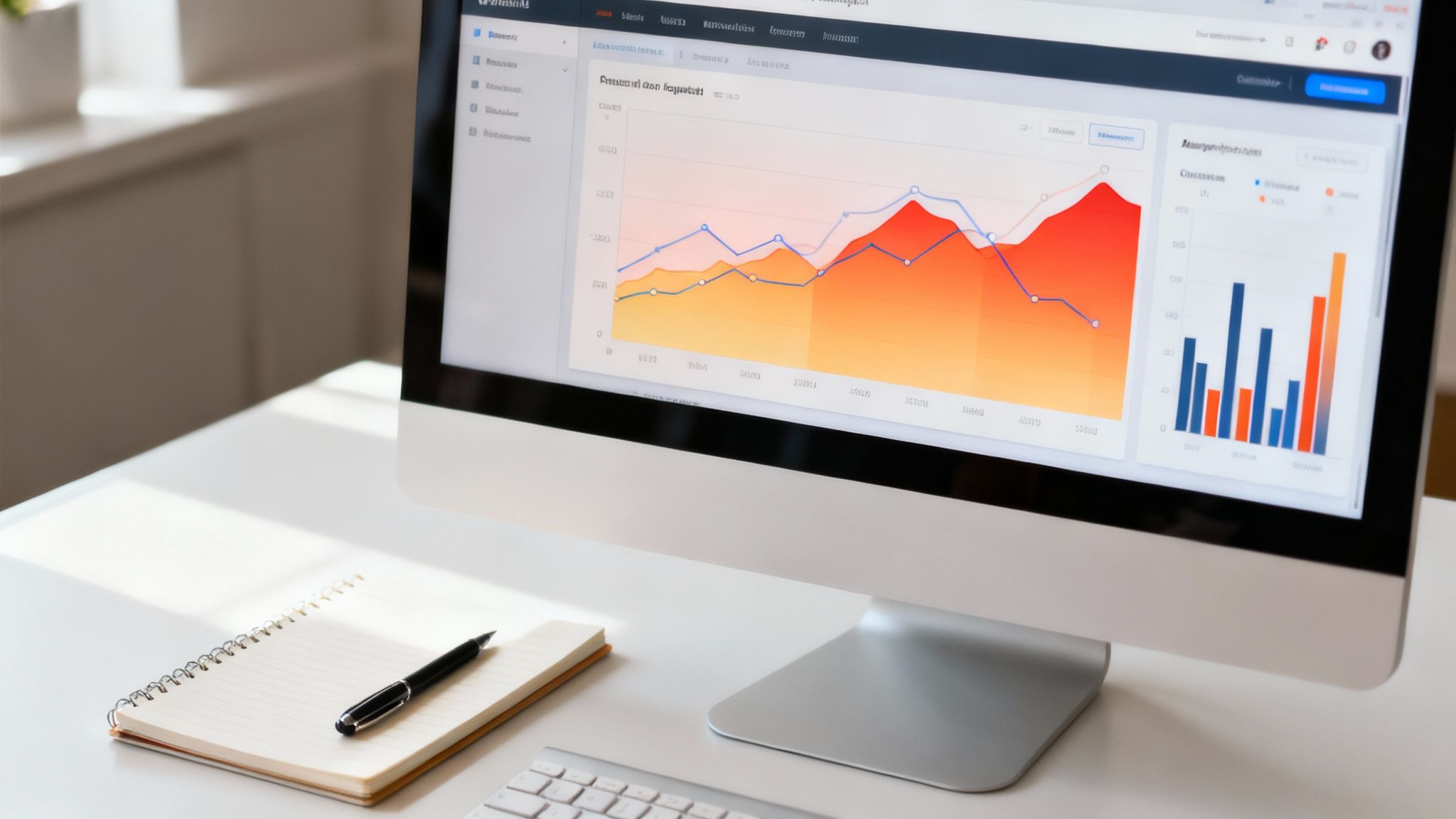
Think of online consumer behavior as a story your customers are telling you with every click, scroll, and pause. But without the right tools, it's easy to miss the plot. To turn all that raw data into a clear narrative, you need a smart way to measure and analyse it. That's how you transform confusing numbers into your greatest strategic advantage.
The real goal isn't just to hoard data; it's to find the meaning behind it. Put on your detective hat. A high bounce rate isn't just a number; it’s a clue that your landing page isn't giving people what they expected. A long session on a single page might mean someone is super engaged, or it could mean they're completely lost. Your job is to figure out which story the data is telling.
Quantitative Analysis: Uncovering the "What"
First up is quantitative analysis. This is all about the numbers—the hard data that tells you what your users are doing. It gives you that big-picture view of your site's performance and how people are moving through it. These numbers are the bedrock of understanding online consumer behavior.
Platforms like Google Analytics are your go-to for this. They track the key metrics that paint a picture of the customer journey.
- Traffic Sources: This shows you exactly where your visitors are coming from—whether it's a Google search, a social media post, or a direct link. It’s how you know which of your marketing channels are actually working.
- Bounce Rate: This is the percentage of people who land on a page and leave without clicking anywhere else. A high bounce rate on a key page could mean your ad copy and your page content aren't aligned.
- Conversion Rate: The holy grail metric. It's the percentage of visitors who do what you want them to do, like buy a product or sign up for a newsletter. This directly measures how successful your website is.
- Average Session Duration: Simply put, how long people stick around. Longer sessions often point to higher engagement and interest in what you're offering.
These numbers give you the skeleton of your customer's story. You get the main plot points, but you're still missing the "why."
A great way to use this is by looking at the conversion paths in Google Analytics. You can see the exact sequence of pages a user visits before they convert. It often reveals that the customer journey is rarely a straight line; people browse around and gather information before they commit.
Qualitative Analysis: Discovering the "Why"
While the numbers tell you what's happening, qualitative data helps you understand why. This is where you get to the human side of the clicks—the frustrations, motivations, and little moments of joy that a standard analytics report will never show you. Getting this right is absolutely critical for analysing online consumer behavior.
This is where you need tools that show you the user experience up close. Heatmaps and user session recordings are perfect for this.
- Heatmaps: These tools create a visual overlay on your website, showing you where people click, move their mouse, and how far they scroll. You'll see "hot spots" in red where all the action is, instantly revealing which buttons get attention and which elements are totally ignored.
- Session Recordings: This is like looking over your user's shoulder. You can watch anonymised recordings of real people navigating your site, showing you exactly where they get stuck, confused, or frustrated.
These qualitative insights add flesh to the bones of your quantitative data. A heatmap might show you that nobody is clicking your main call-to-action button. A session recording could reveal a user trying over and over to click on an image that isn't actually a link. These are the golden nuggets that lead to real, impactful improvements.
Essential Tools for Analysing Consumer Behavior
To really get a handle on what your customers are doing and why, you need a mix of tools. Some give you the big-picture numbers, while others zoom in on individual user experiences. Here’s a quick breakdown of the essential tool categories and what they help you uncover.
| Tool Category | Examples | What It Measures | Best For |
|---|---|---|---|
| Web Analytics | Google Analytics, Adobe Analytics | Traffic sources, page views, bounce rates, conversion goals, user demographics, and pathways through your site. | Understanding what users are doing on your site at an aggregate level and tracking the performance of your marketing channels. |
| Behavior Analytics | Hotjar, Clarity, Crazy Egg | Heatmaps (clicks, scrolls, mouse movement), session recordings, on-page surveys, and feedback polls. | Discovering why users behave the way they do by visualising their interactions and getting direct feedback. |
| Customer Relationship Management (CRM) | Salesforce, HubSpot, Zoho CRM | Customer interactions, purchase history, support tickets, communication logs, and lead scoring. | Building a complete profile of individual customers over their entire lifecycle, from lead to loyal advocate. |
| A/B Testing & Optimisation | Google Optimize, Optimizely, VWO | Performance of different page variations (e.g., headlines, buttons, layouts) against conversion goals. | Making data-driven decisions to improve your website's performance and conversion rates systematically. |
By combining insights from these different tools, you stop guessing and start knowing. You can connect the dots between a drop in conversions (from Google Analytics) and a frustrating checkout button (revealed by a session recording in Hotjar), giving you a clear path to a solution.
Turning Customer Insights Into Winning Marketing Strategies
Think of understanding online consumer behaviour like learning a new language. At first, it's just data points and clicks, but once you get fluent, you can turn those abstract signals into real, impactful conversations with your customers. This is where insight becomes action. The key is to mould your strategies around what you’ve learned, turning that knowledge into measurable growth, no matter your business model.
The goal is always the same: translate behavioural patterns into a better customer experience. You're taking what the data tells you and using it to sharpen your marketing, whether that means selling products online, building long-term business relationships, or just getting more people through your front door. Every bit of data is a clue.
Ecommerce Optimisation Through Behaviour Data
For anyone in the D2C and ecommerce world, the real action happens on the product and checkout pages. This is where the sale is won or lost. Analysing user behaviour here gives you a direct roadmap for what to fix. For instance, a heatmap might show that everyone is completely ignoring a key product feature description, which tells you it’s time to rethink the layout.
Session recordings can be even more of a goldmine. You might watch a customer get visibly frustrated trying to add an out-of-stock item to their cart over and over. That's a clear signal you need better inventory messaging. These insights are pure gold, letting you make specific, data-backed tweaks that fix friction points, lower cart abandonment, and boost your conversion rates. To dig deeper, check out our detailed guide on D2C ecommerce strategy for online sales success.
Mini Case Study: Ecommerce
An online fashion retailer in India was stumped by a 30% drop-off on their checkout page. After watching session recordings, they realised users from Tier-2 cities were bailing when faced with a complicated address form. They simplified it, made the UPI payment option impossible to miss, and saw a 15% jump in completed purchases within a single month.
Nurturing Leads in B2B Sales Cycles
The B2B world is a marathon, not a sprint. The buyer’s journey is long and winding, often involving a whole committee of decision-makers doing a ton of research. Understanding behaviour here is all about patience—nurturing leads with the right content at just the right moment. You can’t rush it. You have to build trust.
By keeping an eye on which white papers, case studies, or webinars a particular lead engages with, you get a solid read on their specific pain points. This lets you personalise your follow-up, moving away from generic email blasts to offering resources that are genuinely helpful. This positions you as a trusted advisor, not just another vendor, which is how you close those big-ticket deals.
Mini Case Study: B2B
A SaaS company selling project management software noticed something interesting on their blog. Leads who downloaded their "Remote Team Collaboration Guide" were twice as likely to request a demo. So, they built a targeted PPC campaign aimed at people searching for remote work solutions, sending them straight to the guide. The result? A 40% increase in qualified leads.
Hyperlocal Campaigns for Local SMBs
For small and medium-sized businesses, online activity is often a direct bridge to an offline action—like walking into a shop. Your most powerful tool here is location-based data. When you analyse "near me" search trends, you see exactly what local customers are looking for, which lets you pack your Google Business Profile with the right keywords and services.
You can even track when people are searching. A local restaurant, for example, might see that searches for "best biryani near me" go through the roof on Friday afternoons. That’s the signal to launch a highly targeted social media ad right then and there, catching customers the moment they’re deciding where to eat and driving that crucial weekend footfall.
Still Have Questions?
Trying to get a handle on online consumer behaviour can feel like hitting a moving target. It’s a common challenge for business owners and marketers alike. To help clear things up, here are some straight answers to the questions we hear most often.
What Is the Biggest Factor Influencing Online Buyers Today?
Price and quality will always matter, of course. But the real king right now? Convenience.
Shoppers expect a completely smooth, fast, and simple ride from the moment they find you to the final click at checkout. We're talking about everything from a mobile-friendly site and easy navigation to guest checkout and transparent shipping. A clunky or slow process is one of the quickest ways to send a potential customer straight to your competitor.
How Is Mobile Shopping Changing Consumer Habits?
The massive shift to mobile-first browsing has made the entire customer journey shorter and way more impulsive. People are now researching, comparing, and buying on the go—often all in the same session.
This means your website absolutely has to be flawless on a small screen. Think lightning-fast load times and thumb-friendly buttons. It’s also why strategies like social commerce and click-to-buy ads are so effective; they meet customers exactly where they are—glued to their phones.
Why Do Customers Abandon Their Shopping Carts?
Shopping cart abandonment is almost always a sign of friction right at the finish line. When someone bails at the last second, it's usually because of one of these deal-breakers:
- Unexpected Costs: Nothing kills a sale faster than surprise shipping fees or taxes popping up at the very end.
- Complicated Checkout: Forcing someone to create an account or slog through a long form is a huge barrier.
- Lack of Trust: If your site is missing security badges or a clear returns policy, shoppers will get nervous and click away.
- Limited Payment Options: In India especially, not offering popular methods like UPI or major digital wallets will stop a sale cold.
Fixing these issues directly will do more than just improve your conversion rates; it creates a much better experience that brings people back.
Ready to turn these insights into a powerful growth engine? Radian Marketing builds data-driven SEO, PPC, and social media strategies that connect with your ideal customers and drive measurable results. Get in touch with us today to start your journey.
Written with Outrank tool