



How to Create an Editorial Calendar for SaaS Content Marketing That Converts Readers Into Users
Many SaaS companies publish content consistently and even rank on Google, yet struggle to convert traffic into demos or free trials.
The problem is not effort. It is lack of alignment.
Content is often created without connecting:
- Search intent
- Buyer journey stages
- Conversion goals
If your blog attracts visitors but does not generate pipeline, your content system is broken.
This guide explains how to create an editorial calendar for SaaS content marketing that turns content into a predictable growth engine, not just a publishing routine.
Let’s dive in.
Why Most SaaS Content Fails to Convert
Most SaaS content fails because it is published without a clear system. Teams post blogs randomly, with no funnel alignment, which leads to traffic without demos or signups.
In most SaaS content audits, the biggest issue is not lack of content but lack of alignment between SEO topics and conversion goals.
Ranking alone does not guarantee conversions when content does not guide users toward the product.
You need to understand that an editorial calendar for SaaS is not just a schedule. It is a revenue planning framework that connects buyer intent, funnel stages, and SEO goals.
This is where SaaS marketing agencies like Radian Marketing helps SaaS brands turn content into a predictable source of qualified leads, not just traffic, by staying ahead of SaaS content trends.
What Is an Editorial Calendar in SaaS Content Marketing?
An editorial calendar in SaaS content marketing is a strategic planning framework that defines what to publish, why to publish it, and how it drives users toward conversion. Unlike a simple posting schedule, a SaaS editorial calendar aligns content with buyer intent, funnel stages, SEO priorities, and revenue goals.
For SaaS companies, a well-structured content calendar for SaaS ensures that blogs, landing pages, case studies, and product-led content work together to attract, educate, and convert the right audience. It connects traffic generation with lead quality, demos, and trials.
Many teams use a basic calendar focused only on consistency. High-performing SaaS brands use a seo-driven content calendar for B2B SaaS that plans content around keywords, ICP pain points, and decision-making stages.
Basic vs Strategic SaaS Editorial Calendar
Choosing the right editorial calendar model directly impacts whether your SaaS content generates revenue or just page views.
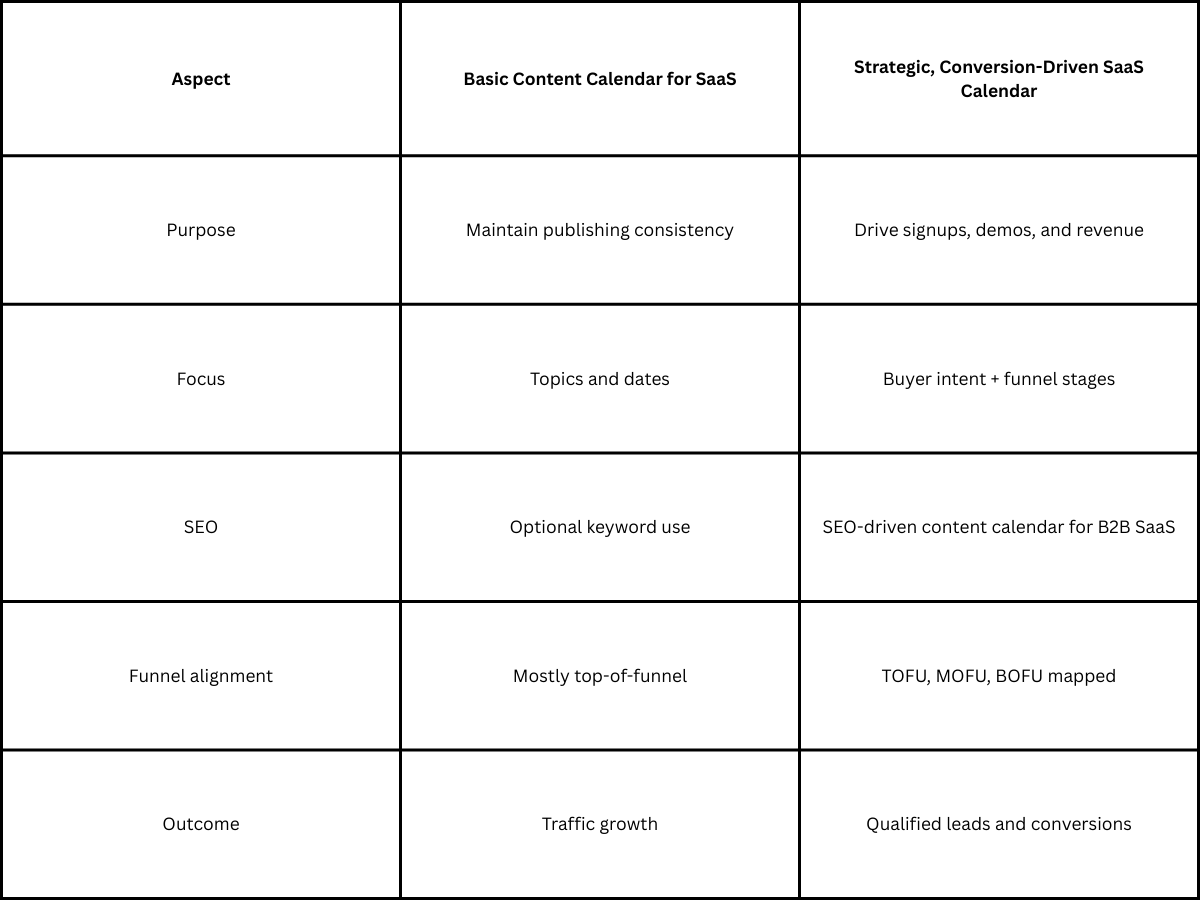
A strategic editorial calendar turns SaaS content into a growth engine, not just a publishing habit.
Importance of a Content Calendar For SEO In SaaS
SaaS SEO does not scale through isolated blog posts. It grows through topical authority, where multiple related pages signal expertise to search engines. This is why the importance of content calendar for SEO in SaaS is far greater than just staying consistent.
A structured content calendar for SaaS helps teams plan content as connected clusters instead of one-off articles. This approach improves rankings, crawlability, and long-term lead quality.
How Content Calendars Strengthen SaaS SEO
Strategic planning ensures every keyword targets buyers, not just visitors.
Build Topical Authority
Plan pillar pages with supporting blogs around one core SaaS problem to own an entire topic.
For instance, if you are from fintech: Create a pillar page on payment fraud prevention software and support it with blogs on chargebacks, transaction monitoring, and PCI compliance. This helps you rank across multiple high-intent fintech searches instead of a single keyword.
Enable Keyword Clustering and Internal Linking
A seo-driven content calendar for B2B SaaS maps primary and secondary keywords before content creation.
For example, if you are from EdTech: Cluster keywords around learning management systems with supporting blogs on student engagement tools, course analytics, and virtual classrooms, all internally linked to the core LMS page.
Prevent Keyword Cannibalization and Content Decay
Assigning clear keyword ownership prevents multiple pages from competing for the same intent.
For example, an HR SaaS company could: Plan one page for employee onboarding software and a separate page for HR automation tools, with scheduled content refreshes to protect rankings over time.
Key Benefits for SaaS Teams
These SEO gains directly translate into better lead quality and higher conversion rates.
- Better keyword coverage across the funnel
- Higher-quality organic leads
- Compounding SEO results over time
These are the real benefits of content marketing calendar for SaaS brands focused on sustainable growth.
How to Create an Editorial Calendar for SaaS Content Marketing (Step by Step)
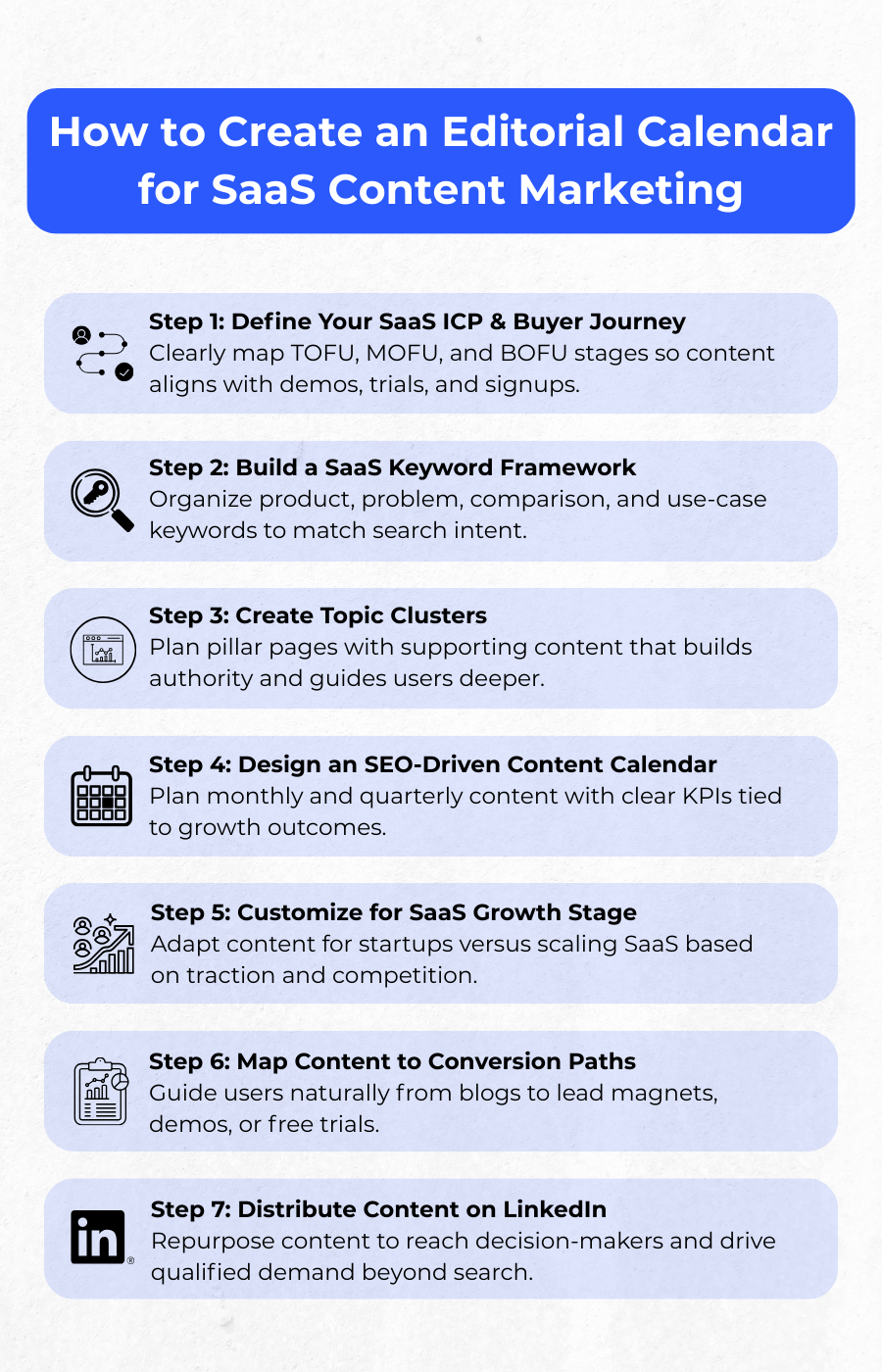
This framework explains how to create an editorial calendar for SaaS content marketing that attracts the right audience and moves them toward demos, trials, and signups. Instead of publishing randomly, each step builds alignment between SEO, buyer intent, and revenue.
Step 1: Define Your SaaS ICP and Buyer Journey
Before planning content, you must understand who you are creating it for and when they need it.
- Map TOFU, MOFU, and BOFU stages clearly
- Identify pain-aware vs solution-aware users
- Align content goals with demo, free trial, or signup actions
This step ensures your calendar supports conversions, not just awareness.
Step 2: Build a SaaS-Specific Keyword Framework
A strong keyword system is the backbone of how to create a content calendar for a SaaS company.
- Product keywords (brand, features, pricing)
- Problem-based keywords (pain points your SaaS solves)
- Comparison and alternative keywords
- Feature and use-case keywords
This structure supports the importance of content calendar for SEO in SaaS by preventing overlap and intent mismatch.
For example, a CRM SaaS may target CRM pricing (product), how to manage sales leads (problem), HubSpot alternatives (comparison), and CRM for small sales teams (use case).
Step 3: Create Topic Clusters That Turn Readers Into Users
Instead of isolated posts, plan content as connected clusters.
- Pillar pages supported by focused blogs
- Internal linking planned inside the calendar
- Old content updates scheduled proactively
This approach strengthens topical authority and guides users deeper into the funnel.
For example, a project management SaaS could create a pillar on project management software with supporting blogs on task tracking, team collaboration, and workflow automation, all linking toward the demo page.
Step 4: Design a SEO-Driven Content Calendar for B2B SaaS
This is where strategy meets execution.
- Monthly and quarterly planning instead of weekly guesswork
- Balanced content mix: educational, solution-led, product-led
- KPIs assigned to each content type (traffic, leads, demos)
A seo-driven content calendar for B2B SaaS ensures every post has a measurable growth role.
Step 5: Customize the Calendar for Different SaaS Stages
Content Calendar for SaaS Startups
- Focus on problem awareness and early traction
- Fewer posts with higher intent
- Fast feedback and validation loops
Content Calendar for Scaling SaaS Companies
- Authority and comparison content
- Feature-led use cases and case studies
- Expansion into competitive keywords
This explains how to create a content calendar for SaaS startups versus growth-stage companies.
Step 6: Map Content to Conversion Paths
Content should guide users naturally, not push sales aggressively.
- Blog to any lead magnet
- Blog to demo or free trial
- Blog to case study
- CTAs aligned with intent, not forced sales
This step turns your calendar into a conversion system, not just a publishing plan.
Need help in creating a converting lead magnet? Book a call with us, let’s connect.
Step 7: Cross-Post and Distribute Content on LinkedIn
Once you create the content, distribution is what turns visibility into demand. For your SaaS company, LinkedIn is a critical channel to reach founders, decision-makers, and buying committees at the right moment.
- Repurpose blogs into short LinkedIn posts, carousels, or thought-leadership threads
- Address core ICP pain points directly, such as poor lead quality, long sales cycles, or low product adoption
- Share problem-led insights at TOFU and solution-led narratives at MOFU and BOFU
You might be wondering I’m already posting on website, how would it move the needle if I post on Linkedin? Well, posting on LinkedIn is crucial because it allows you to meet your ICP where they already consume professional content. Not every founder searches on Google or ChatGPT.
It reinforces your messaging beyond search, builds trust through consistent expertise, and drives qualified traffic back to demos, trials, and case studies.
This final step ensures your editorial calendar does not stop at publishing, but actively supports awareness, engagement, and conversions across channels.
Tools and Templates to Manage a SaaS Content Calendar
Managing a high-performing content calendar for SaaS requires more than ideas and deadlines. The right tools and templates create structure, visibility, and accountability, especially for teams learning how to create a content calendar for SaaS startups with limited resources.
Planning technical content like product documentation and API guides within the same calendar improves internal linking, strengthens SEO, and connects educational content with conversion-focused pages from professional technical writing.
Spreadsheet vs Project Management Tools
Spreadsheets are useful in early stages because they are simple and quick to set up, but they become difficult to manage as content scales. Project management tools add collaboration, ownership, and workflow clarity, supporting the importance of content calendar for SEO in SaaS through consistent and organized execution.
Data Points That Actually Matter
A results-driven SaaS calendar should track:
- Target keyword and supporting keywords
- Search intent and funnel stage
- Content type and topic cluster
- Primary CTA such as demo, trial, or lead magnet
- Internal linking targets
These elements ensure content supports conversions, not just rankings.
Why Most Teams Fail Without a Documented System
Without a documented calendar, teams publish inconsistently, overlap keywords, and lose track of conversion goals. The real benefits of content marketing calendar for SaaS appear only when planning is centralized, repeatable, and enhanced with AI and automation to streamline workflows, optimize keyword targeting, and tie content performance directly to revenue outcomes.
How Radian Marketing Builds Editorial Calendars That Drive SaaS Revenue
Radian Marketing builds editorial calendars as revenue systems, not publishing schedules. Our focus is on how to create an editorial calendar for SaaS content marketing that attracts qualified buyers and moves them toward conversion.
Our approach includes:
- ICP-led keyword research – Keywords mapped to real SaaS buying intent across the funnel.
- SEO + content + conversion alignment – Ensuring every topic supports demos, trials, or signups, not just rankings.
- Full-funnel content execution – From awareness blogs to comparison pages and case studies.
- Data-backed editorial planning – Each piece tied to measurable business goals.
This is how to create a content calendar for a SaaS company and how to create a content calendar for B2B SaaS marketing that consistently drives revenue, not vanity traffic.
Conclusion: Turn Your SaaS Content Calendar Into a Growth Engine
A high-performing content calendar for SaaS should do more than keep publishing consistent. It should drive rankings, qualified leads, and real conversions. When traffic grows but demos do not, the gap is usually missing SEO structure and funnel alignment.
If your SaaS content generates traffic but not leads, the issue is not content volume. It is lack of strategy.
A well-structured editorial calendar connects:
- SEO
- Buyer intent
- Funnel stages
- Conversion goals
When these elements work together, content becomes a predictable source of pipeline growth.
Get a Free SaaS Content Calendar Audit to identify gaps, fix misalignment, and turn your content into a scalable growth system.