How To Stay Ahead of Content Trends In The SaaS Industry With A Smarter Content Strategy
How To Stay Ahead of Content Trends In The SaaS Industry With A Smarter Content Strategy
If you run a SaaS business, you have likely seen this pattern. A content strategy that delivered leads a few months ago suddenly loses momentum. Rankings drop, demo requests slow down, and competitors begin to capture keywords you once owned.
This happens because content trends in the SaaS industry change faster than in most traditional markets. Buyer expectations evolve quickly, search intent shifts, and AI-driven search has transformed how SaaS content is discovered and ranked.
Understanding how to stay ahead of content trends in the SaaS industry is critical because outdated content directly impacts growth:
Low-quality or mismatched traffic reduces pipeline quality
Rising customer acquisition cost due to poor intent targeting
Slower conversions across long SaaS buying cycles
Missed visibility from AI search and voice search optimization
Modern SaaS content strategies focus on relevance, not volume. Search intent alignment, product-led growth content, and freshness signals now determine how to make content rank for SaaS in competitive SERPs.
In this guide, you will learn how to build a smarter, data-driven SaaS content strategy that balances education and promotion, adapts to evolving search behavior, and drives long-term pipeline and MRR growth.
What Makes Content Marketing in SaaS Different?
SaaS content marketing is fundamentally different from content marketing for ecommerce or local services.
Here is why SaaS content trends change faster:
Long sales cycles with multiple decision-makers
Highly informed buyers who research deeply before talking to sales
Crowded SERPs dominated by VC-backed competitors and review platforms
Rapid product innovation that constantly changes positioning
Subscription economics where retention matters as much as acquisition
Unlike traditional industries, SaaS buyers rarely convert after reading one blog. Content must educate, build trust, and guide them across multiple touchpoints, including peer-driven platforms and communities such as subreddits for SaaS business owners where founders actively research, validate tools, and share real-world insights.
This is why generic content calendars and volume-based blogging fail in SaaS.
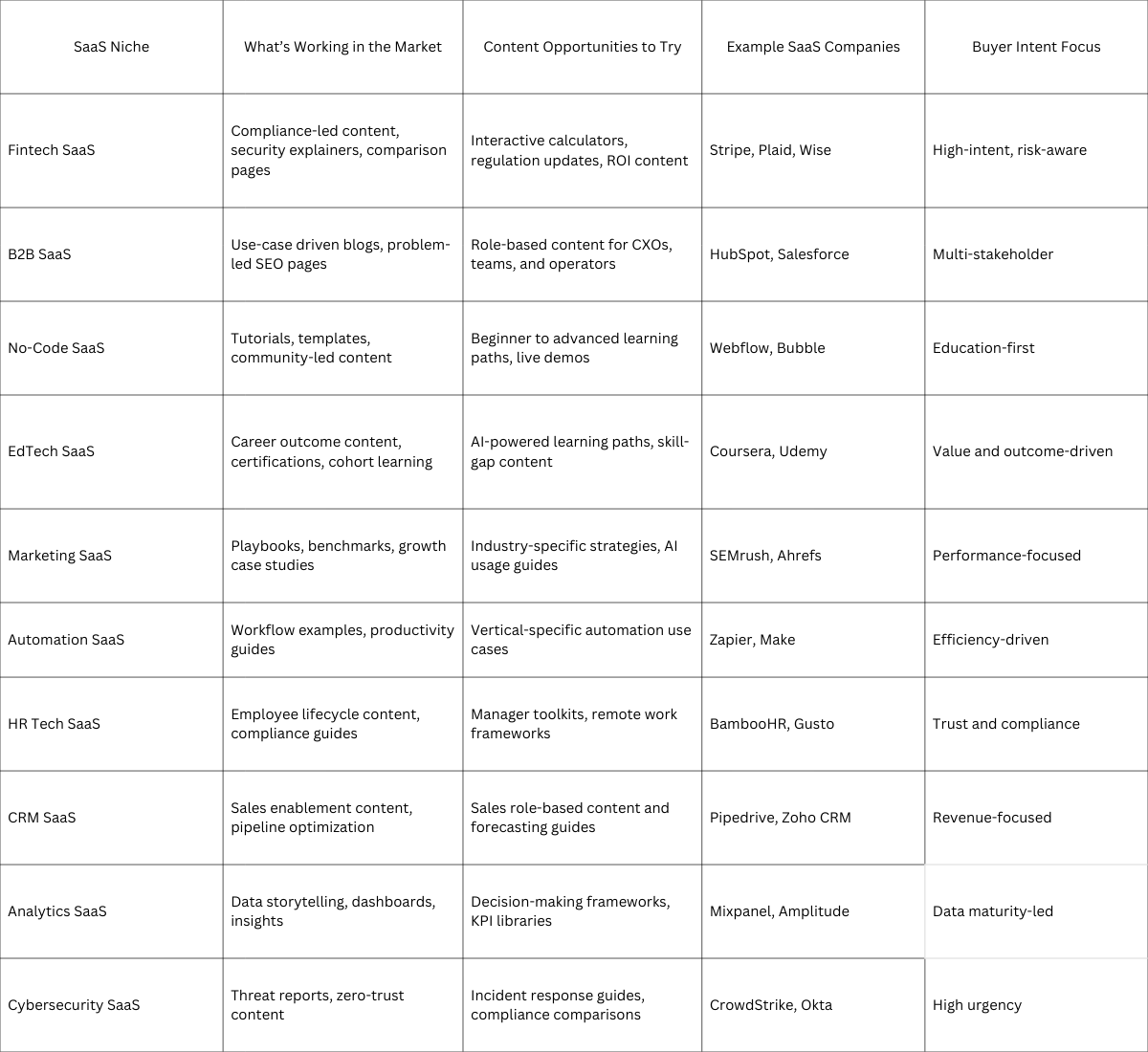
SaaS Content Trends by Industry: What Is Working and What to Try Next
Different SaaS niches require different content strategies. What works for fintech may not work for no-code or edtech platforms. Understanding niche-specific content trends helps SaaS companies align with buyer intent, plan smarter campaigns, and stay competitive in crowded SERPs.
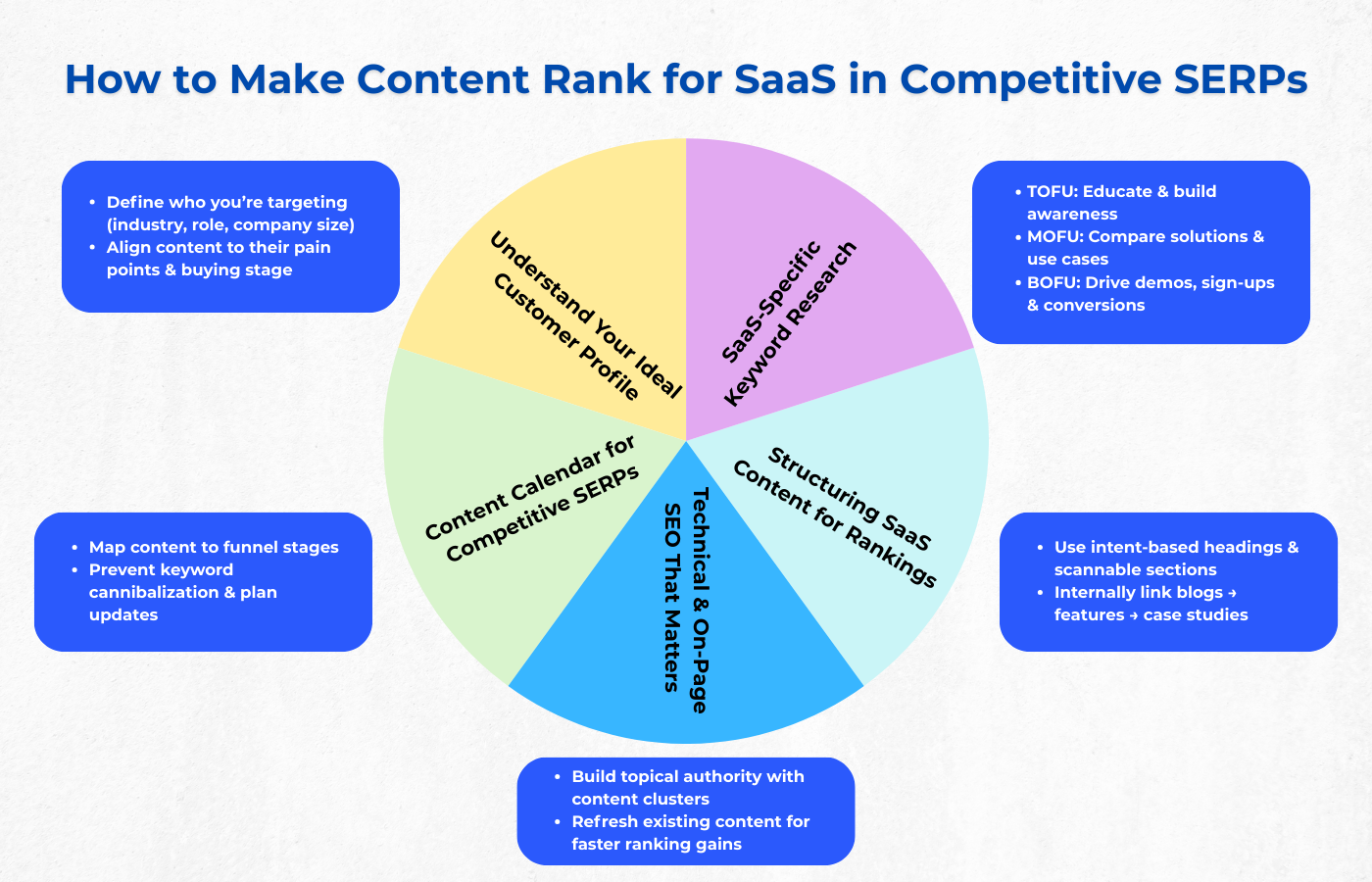
How to Make Content Rank for SaaS in Competitive SERPs
Ranking SaaS content in crowded SERPs requires more than publishing blogs consistently. A high-performing SaaS content strategy is built on intent clarity, structured keyword planning, and content that supports both search visibility and conversions.
Understand Your Ideal Customer Profile (ICP)
Before keyword research, define who your content is for:
Industry and company size
Decision-maker vs end-user
Awareness stage in the buying journey
Primary pain points and triggers
When ICP is clear, your SaaS content attracts users who are more likely to convert, not just browse.
SaaS-Specific Keyword Research Framework
To make content rank for SaaS, keywords must be mapped across the full funnel. SaaS buyers do not search the same way at every stage. Their queries evolve from learning a problem to evaluating solutions and finally choosing a product.
TOFU keywords (Top of Funnel)
TOFU keywords target users who are still learning or exploring a problem. These searches are informational and education-focused.
If you are an EdTech SaaS, TOFU keywords might look like:
What is online learning software
How does digital education work
What is SaaS automation in education
How to improve student onboarding in EdTech platforms
These keywords help attract early-stage users and build awareness.
MOFU Keywords (Middle of Funnel)
MOFU keywords target users who understand the problem and are actively comparing tools or approaches.
For a Marketing SaaS, MOFU keywords may look like:
Best SaaS content marketing platforms
Marketing automation tools comparison
Best SaaS project management tools for marketing teams
Content analytics software for SaaS
At this stage, content should focus on differentiation and use cases.
BOFU Keywords (Bottom of Funnel)
BOFU keywords capture high-intent users who are close to making a purchase decision.
For a Fintech SaaS, BOFU keywords could include:
Tool A vs Tool B for payments
Fintech SaaS pricing and alternatives
Best payment gateway for startups
Fintech software integrations
BOFU content directly supports demos, sign-ups, and sales conversions.
In addition, prioritize:
Product-related keywords
Pain-point keywords
Comparison and alternative keywords
This approach builds topical authority while supporting different buying stages.
This balance supports both SEO performance and buyer trust.
Educational vs Promotional SaaS Content Examples
Educational SaaS content
Blog posts explaining problems or trends
Industry guides and best practices
Promotional SaaS content
Landing pages and demo pages
Feature pages and product updates
Both are essential. The key is placing them at the right stage of the buyer journey.
How to Measure SaaS Content Marketing Performance
To understand how to measure SaaS content marketing, SaaS teams must focus on revenue-driven metrics, not just traffic. In effective SaaS marketing, content success is measured by its impact on growth and pipeline.
Key metrics that matter:
Organic pipeline to track leads and revenue influenced by content
Assisted conversions to understand how SaaS content supports long buying cycles
Content-driven sign-ups or demos to measure high-intent engagement
Tracking these metrics helps SaaS brands align content strategies with evolving content trends in the SaaS industry and continuously improve performance.
How Radian Marketing Helps SaaS Brands Stay Ahead of Content Trends
Radian Marketing helps SaaS companies stay ahead of content trends in the SaaS industry by building scalable, intent-driven systems, not one-off campaigns. Our approach to SaaS marketing and SaaS content marketing is designed to drive visibility, qualified pipeline, and long-term growth.
We support SaaS brands with:
SaaS-focused SEO and content systems built around ICPs, funnel stages, and competitive SERPs
Data-backed editorial planning, including guidance on how to create a content calendar for a SaaS company that aligns with growth goals
Full-funnel SaaS content execution, from educational blogs to comparison and conversion pages
Conclusion: Now Is the Time to Capitalize on SaaS Content Marketing Trends in 2026
Winning SaaS brands invest in trend-aware, intent-driven content, not short-term volume. As content trends in the SaaS industry continue to evolve, success will depend on systems that connect strategy, execution, and measurement.
SaaS content marketing works best when planned for the long term. Founders and marketers who build sustainable content engines today will own organic growth tomorrow.
As an agency having expertise in SaaS industry, Radian Marketing has worked with numerous startups and mid-sized SaaS businesses to pace up their marketing goals. Book a call to explore how we can help your company achieve online growth.
Frequently Asked Questions
Table of Contents
FAQs
1. What is b2b saas marketing
B2B SaaS marketing is the strategy used to attract, convert, and retain business customers for subscription-based software. It focuses on long sales cycles, educational content, multi-touch demand generation, and driving trials or demo bookings that lead to recurring revenue.
2. How to choose a marketing agency for b2b saas
Choose an agency that specializes in SaaS, understands complex buyer journeys, offers proven case studies, and provides transparent reporting tied to pipeline and revenue. Look for a full-funnel strategy combining SEO, paid ads, content, and CRM automation.
3. How to choose a marketing agency for saas startup
We provide the most user-friendly service for you to develop your software with the best user-experience design. You can come up with an idea, design plan or we are open for discussion to help you to develop your desired software efficiently.
4. How to choose marketing channels for early stage saas
Early-stage SaaS should focus on channels that give fast feedback, such as SEO, Google Search Ads, LinkedIn outreach, Reddit communities, and email onboarding. Prioritize channels where your ICP actively searches for solutions.
5. What marketing channels works best for bootstrapped saas
Bootstrapped SaaS companies succeed with low-cost, compounding channels like SEO, content marketing, community engagement (Reddit, Indie Hackers), founder-led LinkedIn content, referral loops, and highly targeted cold outbound.
6. How to choose marketing channels for enterprise saas
Enterprise SaaS requires trust-building channels like LinkedIn Ads, ABM campaigns, webinars, events, long-form content, and SEO. These help reach decision-makers, support multi-touch buying journeys, and create high-quality pipelines.
7. How to measure roi of saas marketing agency services
Track ROI using SaaS-specific metrics such as CAC, LTV, CAC Payback Period, pipeline creation, qualified demos, organic growth, and trial-to-paid conversions. A good agency will provide clear attribution and real-time dashboards.
8. Which is best between SaaS marketing agency and in-house team
An agency is better when you need specialized skills, faster execution, and scalable demand generation at a lower cost. An in-house team is better for mature SaaS companies that need full-time ownership and long-term brand control. Many SaaS brands use a hybrid model for best results.
9. What kind of tools do you use for SaaS and AI product marketing?
We use several tools as per the marketing channels. Semrush, Rankability, Ahrefs, Google analytics, Hubspot, Activecampaign, Hubspot, Linkedin Sales Navigator, etc.
About The Author
Bhaskar Gupta
Bhaskar Gupta is a passionate digital marketing practitioner and has keen interest in SEO, Social Media Strategy, Business Digital growth, and Performance marketing. He has worked with multiple brands in different industries across India and abroad. In 2022, he has set up his own digital growth and marketing agency named Radian Marketing.
This article was edited by the Radian Marketing editorial team. Radian Marketing is committed to providing actionable insights and transparent coverage of digital marketing, SEO, Facebook marketing, CRO and growth strategies.